
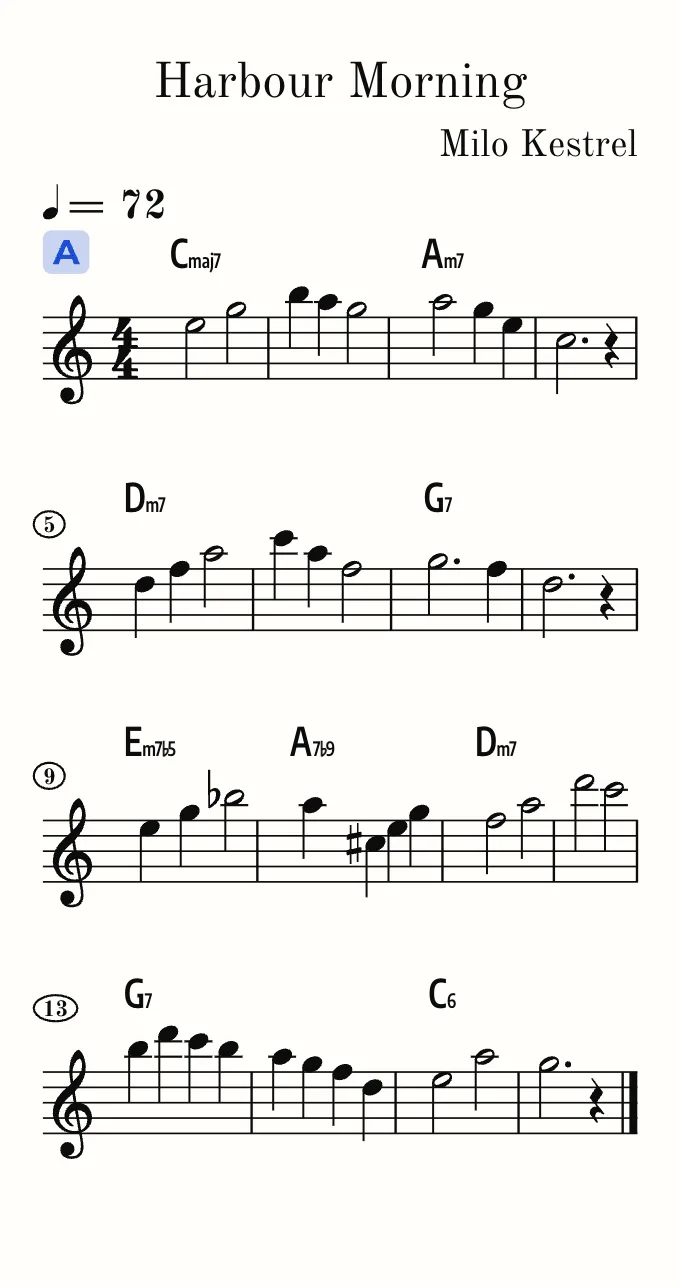
To write a lead sheet, set out the song's form first, then write the melody on a single treble staff in concert pitch, put the chord symbols above the staff where each chord changes, and the lyrics under the notes, one syllable per note. Add a header (title, composer, key, tempo, style), mark the sections, and use repeats and endings to keep it to one or two pages. That is the whole job: melody, harmony and words, and nothing a player has to work round. The steps below go in the order that saves the most rubbing out.
What goes on a lead sheet, and what does not?
A lead sheet carries:
- the melody, on one staff;
- the chord symbols, above it;
- the lyrics, if the song has words, under the melody;
- the form: section letters, repeats, endings, D.S. and coda;
- a header: title, composer, key signature and time signature, tempo, style.
It does not carry a piano accompaniment, a bass line, voicings, or separate instrument parts. Everyone reads the same page and makes their own part from it. That is what makes it different from sheet music, which writes the accompaniment out, and from a chord chart, which leaves the melody off; chord chart vs lead sheet vs score compares the three.
Step 1: work out the form and count the bars
Before a single note, list the sections and their length in bars (measures): "Intro 4, A 8, A 8, B 8, A 8". Then decide how the page will hold them. Write four bars to a line (a "system"): phrases of 4 and 8 bars then line up, and an 8-bar section is two lines that start at the left margin. A 32-bar tune fits on one page with room for an intro and an ending.
Decide now what you will repeat. Two A sections that differ only in their last two bars are one A with first and second endings. A last A identical to the first can be a D.S. or D.C. al Coda. Fewer jumps are easier to read, so use them only to save a page turn.
Step 2: choose the key and the clef
Write the lead sheet in concert pitch, in the key the song is played in, in treble clef. A melody for a low voice is still written in treble clef, an octave higher than it sounds, the way tenor parts are. Horn players will transpose it, or you make a separate B♭ or E♭ copy (see transposing instruments).
Put the key signature on every line, and the time signature on the first line only (and wherever it changes). If the song changes key, write a double barline and the new key signature there.
Step 3: write the melody's rhythm, then its pitches
Get the rhythm right first: sing or play the tune slowly, bar by bar, tapping the beat, and write the note lengths. Then add the pitches. A melody with the right pitches and the wrong rhythm is unreadable; the reverse is easy to fix.
Write rhythms the way they are felt, simply:
- Show the beats. Beam eighth notes (quavers) in groups that show where the beats fall; in 4/4, beam them in twos or fours, never across the middle of the bar.
- Keep beat 3 visible in 4/4. A note that starts off the beat and runs across the middle of the bar is clearest written as two tied notes, so the reader sees where beat 3 falls.
- Do not write a singer's phrasing. Write the plain version of a vocal rhythm, the one the song is built on, not every push and delay from one performance. Each singer will phrase it their own way.
- Swing: write straight eighths and put "Swing" or "Medium swing" at the top. Don't spell swung eighths out as dotted rhythms: the swing ratio changes with the tempo, wider when slow and narrower when fast, and with the player.
- A pickup (a melody starting before the first downbeat) goes in a short first bar with just the pickup's beats. It is not counted as bar 1. See pickup bars.
Step 4: put the chord symbols over the staff
Each chord symbol goes above the staff, over the beat where the chord changes, even when no new note starts there (a held note or a rest). In a bar with two chords in 4/4, the second sits over beat 3. Keep them all at one height above the staff, above the highest notes, so the eye reads them as one line.
Use the same spelling throughout (Cmaj7 every time, not Cmaj7 here and CM7 there; how to write chord symbols has the choices), and spell chords for the key: B♭7 in F, not A♯7. Repeat the chord at the start of each new line if it is still sounding; a player who looks down mid-song should not have to look back a line to find it.
Step 5: add the lyrics
Write the lyrics of the first verse under the melody, one syllable under each note:
- Split words into syllables with hyphens, centred between the notes: "a-gain", "wait-ing".
- When one syllable is sung over several notes, draw an extender line after it, under the notes it lasts.
- Other verses go either as extra lines of lyrics under the first (verse 2 under verse 1) or, when they share the melody exactly, in a block of text after the music. Two or three stacked lines are the most that stay readable; beyond that, write the chorus once and send the verses back to it with a repeat or a D.S.
Here is the opening of a tune written for this article, in F, laid out the way it would be written:
| Bar | Chord | Melody | Lyric |
|---|---|---|---|
| 1 | Fmaj7 | A (quarter), C (quarter), E (half) | Late a-gain, |
| 2 | Gm7, then C7 on beat 3 | D (half), E (quarter), B♭ (quarter) | streets are wet, |
| 3 | Fmaj7 | A (whole) | home |
| 4 | Am7♭5, then D7 on beat 3 | G (half), F♯ (half) | is near |
On the staff, the C7 sits over the E on beat 3 of bar 2, and the D7 over the F♯ in bar 4.
Step 6: mark the form and the road map
- A section letter or name in a box over the first bar of each section: A, B, Verse, Chorus.
- Double barlines at the end of each section, repeat barlines where you repeat, and numbered brackets for the endings.
- Segno, coda signs and D.S. al Coda exactly where the jumps happen.
- At the top, the style and tempo: "Bossa nova, ♩ = 132", "Slow ballad".
- If the song has an intro, write it out, or write "Intro: last 4 bars" if that is how the band plays it.
Step 7: check it as a player would
Play or sing through the page exactly as written, with someone playing the chords if you can. Check:
- Every bar adds up to the time signature.
- Every accidental is right, and a note sharpened earlier in a bar is natural again in the next one.
- The chords fit the melody. A melody note clashing with its chord is either a wrong note or a wrong chord.
- The road map works: follow every repeat and jump in order.
- The range is singable or playable in the written key.
Then give it to a musician who does not know the song. If they can sing the tune from it, it is done. How to read a lead sheet is what they will be doing, from the other side of the page.
Can you write a lead sheet in an app?
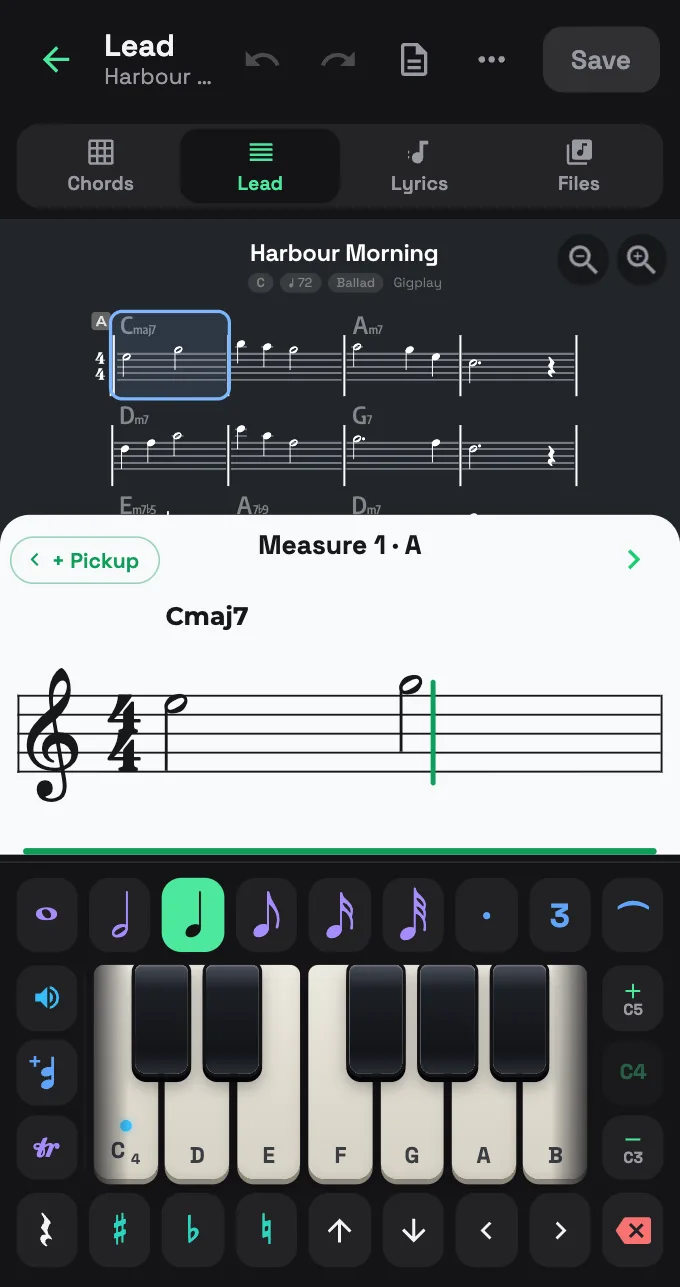
Yes, and it saves the redrawing. In Gigplay you write the chords on the chart first, then the melody on a piano keyboard in the editor's Lead tab: choose a length (Quarter, Eighth, Dotted…), tap a key, and the note is written in its bar. Score then shows the lead sheet, the melody on staves with the chords over it, in any key you choose (see Melody and lyrics).