

A chord chart shows the chords bar by bar (measure by measure) and the form, and nothing else. A lead sheet adds the melody on a single staff, with the chords above it and the lyrics under it. Sheet music, in the sense of a piano-vocal arrangement, writes out the whole accompaniment as well, and a score holds every instrument's part. Use a chord chart for a rhythm section that will make up its own parts, a lead sheet when someone needs the tune, sheet music when a pianist should play an arrangement as written, and a score and parts when the arrangement is fixed for every player.
What is the difference at a glance?
| Format | What is on it | Who reads it | Best for |
|---|---|---|---|
| Chord chart | Chords, bar by bar, the form, hits | Rhythm section: keys, guitar, bass, drums | Bands that know the tune or make their own parts |
| Lead sheet | Melody on one staff, chords above, lyrics below | Everyone: singers, horns, rhythm section | Learning a tune, jazz, jams, fake books |
| Lyric sheet with chords | Words with chord names over them | Singers, guitarists | Singalong songs, a singer leading the band |
| Nashville number chart | Chords as numbers in the key, bar by bar | Session musicians, bands that read numbers | Songs that change key from singer to singer |
| Sheet music (piano-vocal) | Melody, plus a full piano part in both hands, often chords too | Pianists, singers with a pianist | Playing an arrangement as written |
| Score and parts | Every instrument's notes; each player reads their own part | Big bands, horn sections, orchestras | Fixed arrangements |
What is a chord chart for?
For the players who make up their own parts from the harmony: piano, guitar, bass, drums (how to read a chord chart is written for them). A chord chart says what the chord is and when, how the song is put together, and what the band does together (hits, stops, endings). It leaves out the melody, so it fits a whole song on one page, and a player can see the form at a glance:
| Section | Bar 1 | Bar 2 | Bar 3 | Bar 4 |
|---|---|---|---|---|
| A | Fmaj7 | Gm7 C7 | Am7 | D7 |
| Gm7 | C7 | Fmaj7 | C7 |
The weakness is the same as the strength: a chart cannot teach anyone the tune. A guitarist who has never heard the song can play it from a chart; a singer who has never heard it cannot. How to write a chord chart covers making a good one.
What does a lead sheet add?
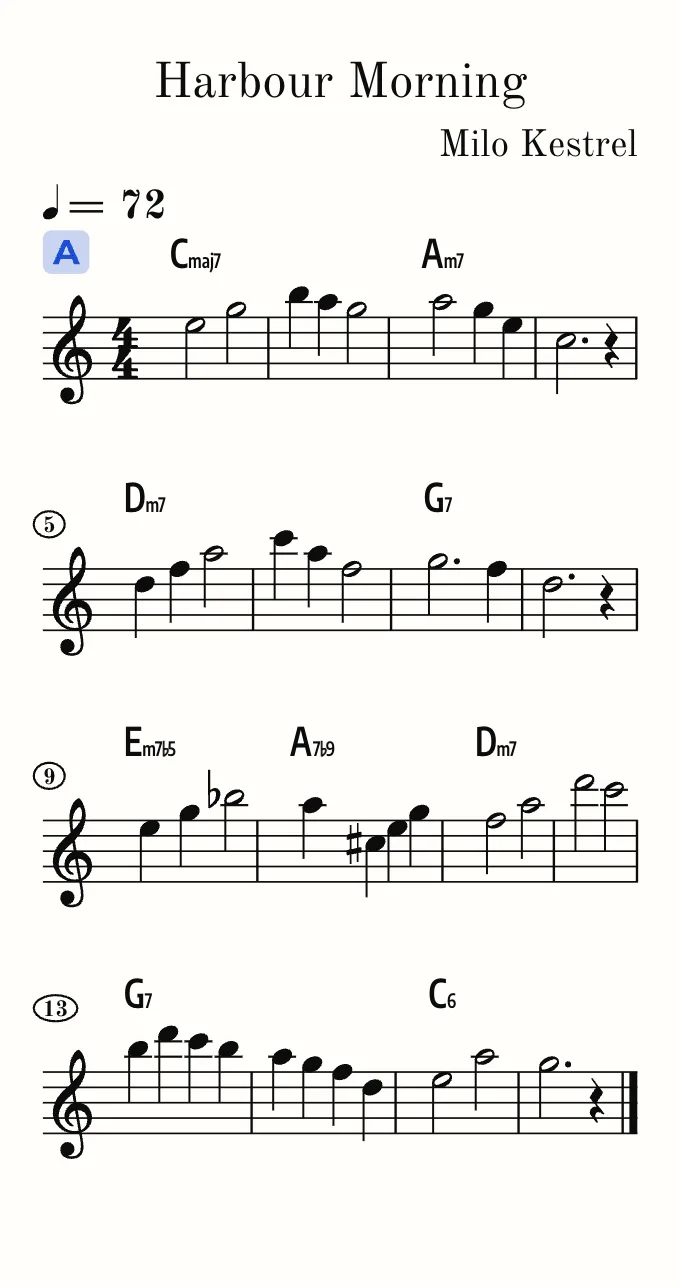
The melody. A lead sheet has the tune written on one treble staff, the chord symbols above it, and the lyrics of the first verse under the notes. The whole band reads from the same page: the singer or horn plays the melody, the rhythm section reads the chords.
It is often the only written music a small jazz group uses, and a collection of lead sheets is what musicians call a fake book. In the music business it is also the document that describes a song for legal purposes: the form of the song to which copyright applies. How to write a lead sheet goes through it step by step.
The cost is length and reading. A lead sheet runs longer than a chart, the melody pushes the chords apart on the page, and it asks for real music reading.
Lead sheet vs sheet music: what is the difference?
"Sheet music", as sold for a song, is often a piano-vocal arrangement: the vocal melody on a top staff, with lyrics, and under it a two-staff piano part with the accompaniment written out note for note, often with chord symbols on top. It is an arrangement: someone has decided what the piano plays.
A lead sheet has no accompaniment. The pianist reading it decides the voicings, the rhythm and the bass line from the chord symbols. So:
- A pianist who reads well but does not improvise is happier with sheet music.
- A band, or a pianist who comps, wants a lead sheet or a chart. Sheet music has too much on it to read at speed, and its piano part fights the bass player.
Where do scores and parts fit?
A score stacks every instrument's part, one staff above the other, so the conductor or arranger sees everything at once. Players read parts: their own line, extracted from the score. In a big band, the horns read written-out parts, while a rhythm section part can be mostly chord symbols and slashes, with the important figures written in. If the arrangement is written, use parts; if it is in people's heads, use charts or lead sheets.
What about lyric sheets and number charts?
A lyric sheet with chords suits singers and acoustic guitarists: the words, with the chord names over the syllables where they change. It is easy for a singer to lead from, but it shows no bar lengths, so a bass player new to the song can get lost in a long held note. How to write chords over lyrics shows how to keep the chords lined up and the bars visible.
A Nashville number chart is a chord chart with numbers instead of letters: 1, 4, 5, 6m, counted from the key, so it works in any key without rewriting. See how to make a Nashville number chart.
Which one should you bring?
| Situation | Bring |
|---|---|
| A jam or a jazz gig | Lead sheets, or charts for the tunes everyone knows |
| A function or covers gig as a dep | Charts with clear road maps, plus lyric sheets for the singer |
| A worship team | Lyric sheets with chords for the singers, number charts or chord charts for the band |
| A session or a new original song | A chart for the rhythm section, a lead sheet for the singer, parts for written horn lines |
| Teaching a tune | A lead sheet, so the student learns melody and harmony together |
Can one song be all of these?
If the song is stored as chords, melody and lyrics rather than as a picture of a page, yes: each format is a different view of the same information. In Gigplay, a song's modes do exactly that. Chords shows the chart, Chords+Melody the chart with the melody on a small staff in each bar, Score the lead sheet, and Lyrics the words with their chords, all on the same song, a swipe or a tap apart (see Reading a song).
Whatever you use, the rule is the same: give each player the least they need to play their part well, and no more.