

To write a Nashville number chart, put the key at the top, then write each chord as its number in that key (1 for the tonic, 4 and 5 for the chords built on the fourth and fifth notes of the scale, and so on), one number for each bar (measure), four bars to a line, with the sections named down the left side. A plain number is a major chord; a dash makes it minor (6-, also written 6m). Bars with two chords are grouped by underlining, or in parentheses. Because nothing on the page names a letter, the same chart works in any key: the singer calls "in B♭" and nobody rewrites a thing.
What do you need before you start?
The same as for any chord chart: the key, the time signature, the tempo and feel, and the form with every section's length in bars. Count the form carefully. A number chart is compact, and a miscounted section is easy to miss in it. If the Nashville number system itself is new to you, start there; this page is about putting it on paper.
How do you work out the numbers?
Number the notes of the major scale of the key from 1 to 7, and give each chord the number of its root. In a major key, the chords that belong to the key are:
| Number | Chord | In C | In G | In D | In E | In B♭ |
|---|---|---|---|---|---|---|
| 1 | major | C | G | D | E | B♭ |
| 2m | minor | Dm | Am | Em | F♯m | Cm |
| 3m | minor | Em | Bm | F♯m | G♯m | Dm |
| 4 | major | F | C | G | A | E♭ |
| 5 | major | G | D | A | B | F |
| 6m | minor | Am | Em | Bm | C♯m | Gm |
| 7° | diminished | B° | F♯° | C♯° | D♯° | A° |
Nashville charts write the minor with a dash, 6-, or with an m, 6m; they mean the same, and this page uses 6m in its tables.
A chord from outside the key gets its number anyway, with what makes it different written on:
- A major chord where the key has a minor one is just the number: 2 is a major chord on the second degree (D in C), which usually leads to 5.
- A flattened root takes a ♭ before the number: ♭7 is B♭ in C, ♭6 is A♭, ♭3 is E♭.
- Sevenths and colours go after the number as on any chord symbol: 5⁷ for G7 in C (with the 7 raised; typed as
5(7)where superscript is awkward, never as 57, which reads like a bar of 5 and 7), 1maj7, 2m7, 4sus. - Slash chords are written as a number over a number: 1/3 is C with E in the bass, 4/5 is F over G. Said "one over three".
How do you write the bars?
One number is one bar, the same grid as a chord chart template with numbers in the boxes. In 4/4, "1" means four beats of the 1 chord; in 3/4, three beats. Four numbers make a line, and each section starts on a new line with its name at the left.
Split bars, two chords in one bar, are written side by side and underlined together so the eye reads them as one bar, split evenly. In typed charts where underlining is awkward, parentheses do the same job: (1 4) is half a bar of each. A split bar is read as even unless it is marked otherwise. For an uneven split, show the beats, for example with a dot for each beat a chord holds, 1 . . 4 for three beats of 1 and one of 4, and say so on the chart.
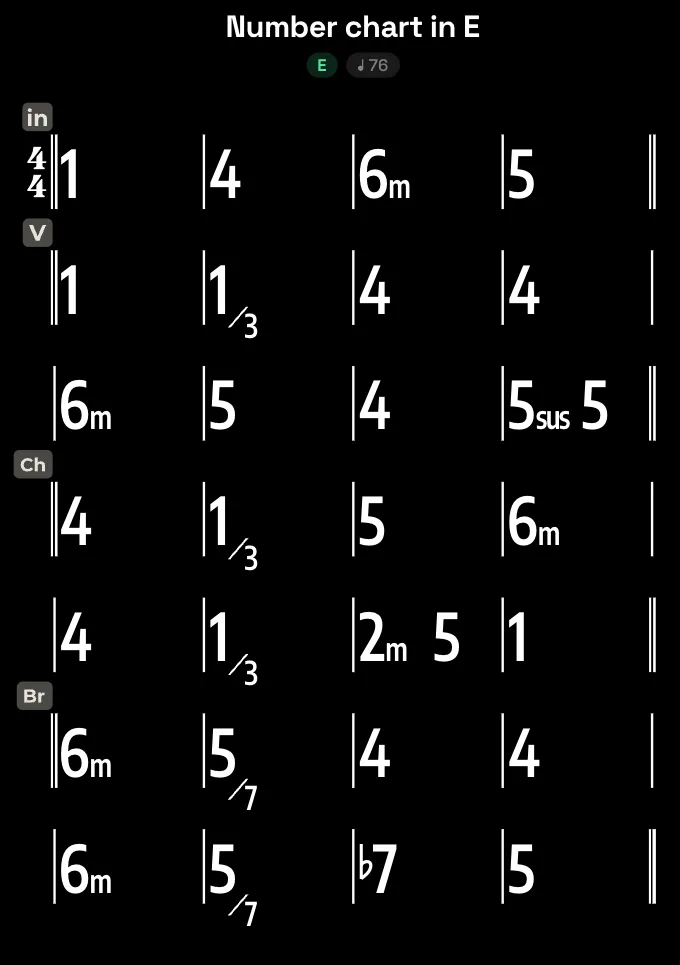
Here is a song written for this article, in E, 4/4, as it might be charted. Parentheses show split bars:
| Section | Bar 1 | Bar 2 | Bar 3 | Bar 4 |
|---|---|---|---|---|
| Intro | 1 | 4 | 6m | 5 |
| Verse | 1 | 1/3 | 4 | 4 |
| 6m | 5 | 4 | (5sus 5) | |
| Chorus | 4 | 1/3 | 5 | 6m |
| 4 | 1/3 | (2m 5) | 1 | |
| Bridge | 6m | 5/7 | 4 | 4 |
| 6m | 5/7 | ♭7 | 5 |
In E, the first chorus line is A, E/G♯, B, C♯m. Called in B♭, it is E♭, B♭/D, F, Gm. In G, C, G/B, D, Em. The page does not change.
How do you show the road map?
A number chart is easiest to read written top to bottom in the order the song is played, with few jumps. Some ways to do it:
- Section names abbreviated: In, V1, V2, Ch, Br, Solo, Tag, Out.
- "x2" beside a line or section played twice.
- A section played again, identical, written once more as its name alone ("Ch") on its own line, or the whole order written along the top: "In V Ch V Ch Br Ch Ch Out".
- A key change written where it happens ("Key: F♯" or "up a whole step"), with the numbers after it counted from the new key.
Repeat signs, D.S. and codas work on number charts too, but a number chart is compact, and written out in order it may still fit on one page.
What do the diamonds, pushes and other marks mean?
Number charts carry rhythm and dynamics with a few marks over or around the numbers. These marks are not standardized, so put a line of explanation on a chart for players who have not worked with you. Common ones:
- A diamond drawn around a number: hit the chord and let it ring.
- A push:
<before the number, as in<4, meaning the chord arrives an eighth note early, on the "and" of the beat before; an eighth note tied over says the same. See pushes, kicks and hits. - A choke or stop: a marcato sign (^, the "hat") or a staccato dot over the number, meaning hit it and cut it off at once.
- A fermata over the last number: hold it until the leader cuts it off.
- Words, kept short: "band out", "drums only", "build", "half-time".
Typed, the chorus of the example above, with a push into its third bar and dashes for minor, looks like this:
Key: E    4/4    ♩ = 76

Ch    4        1/3      <5       6-
      4        1/3      (2- 5)   1
Write what everyone plays. Parts that only the guitarist plays belong in the guitarist's head, or on their own sheet.
How do you write a song in a minor key?
In the Nashville number system the standard is to count from the relative major: a song in A minor is charted in C, so its home chord is 6-, and the other chords keep the numbers they have in the major key (2-, 3, 4, 5).
Counting from the minor tonic (home is 1-, then 4-, 5- or 5, ♭6, ♭7) turns up on some number charts too. It matches Roman-numeral habits, but a Nashville player will not assume it.
Say which you mean at the top: "Key: Am (6- = home)" or "Key: Am (1 = A)". Players will read either, but not if they have to guess.
When is a number chart better than letters?
When the key may change. A worship team, a band backing different singers, or a session where the artist tries two keys before settling: the number chart needs no rewriting, and it shows the harmony's function as well. Planning a worship set shows how a team can use them. A rhythm section reading jazz harmony with many altered chords may find letters easier.
In Gigplay you write a chart in letters and read it as numbers: Chords as, then Nashville, shows every chord as its number in the song's key (Dm7 in C as 2m7). Change the key with the Key pad and the letters move while the numbers stay as they are (see Reading a song).
A last check
Read the chart back in a second key, out loud, before anyone else does. If every number still makes sense as a chord, and every line has four bars or says why not, it is ready.