A slash chord is a chord with a named bass note. The chord is left of the slash, the bass note right of it: C/E means "a C chord, with E in the bass", read "C over E". The bass player plays E; the pianist or guitarist plays a C chord, C E G, ideally with E as its lowest note too. It is not a fraction and not two chords one after the other. When the bass note belongs to the chord, as E does to C, the slash chord is an inversion; when it doesn't, as in D/C, it makes a new sound that a plain chord symbol could not name as neatly.
How do you read a slash chord?
Left of the slash: any chord symbol, read the usual way (the chord symbols chart has them all). Right of it, in a chart in letters: a single note, just a letter with its sharp or flat. Never a quality.
| Symbol | Chord | Bass | Notes from the bottom |
|---|---|---|---|
| C/E | C major | E | E, then C G (and E) |
| C/G | C major | G | G, then C E |
| Am/G | A minor | G | G, then A C E |
| G7/F | G7 | F | F, then G B D |
| D/F♯ | D major | F♯ | F♯, then D A |
| F/G | F major | G | G, then F A C |
| D/C | D major | C | C, then D F♯ A |
The rule of thumb for sight-reading: bass players read right of the slash, everyone else reads left of it.
What is the difference between a slash chord and an inversion?
An inversion is a chord with a note other than the root at the bottom. Slash notation is how a chart writes it:
| Inversion | Of C | Of G7 | Classical figure |
|---|---|---|---|
| Root position | C | G7 | I, V7 |
| First inversion (third in the bass) | C/E | G7/B | I6, V65 |
| Second inversion (fifth in the bass) | C/G | G7/D | I64, V43 |
| Third inversion (seventh in the bass) | G7/F | V42 |
Every inversion can be written as a slash chord. But not every slash chord is an inversion: in D/C, C is not in a D chord at all. Those slash chords are best thought of as "chord over bass", and they are where the notation earns its keep.
In the Nashville number system, the same idea is written with numbers: in C, C/E is 1/3, F/C is 4/1, G/B is 5/7. In Roman numeral analysis, classical writers use the figures in the table above instead of a slash.
Why use slash chords at all?
Three common reasons.
To write a bass line
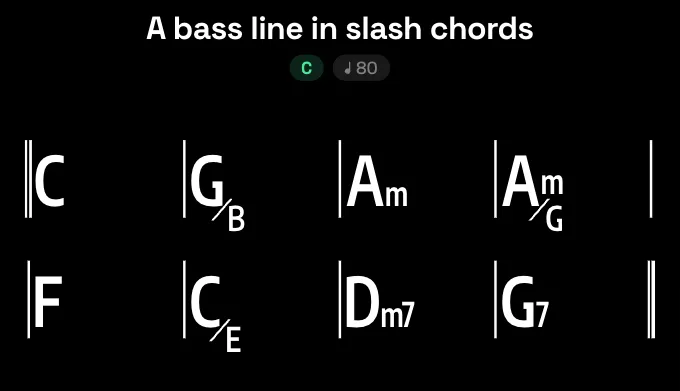
A slash bass can write a descending or rising line under a chord progression. Without the slashes, the bass would jump from root to root; with them, it walks step by step. In C, a bar (measure) each:
| Bar | 1 | 2 | 3 | 4 | 5 | 6 | 7 | 8 |
|---|---|---|---|---|---|---|---|---|
| Chord | C | G/B | Am | Am/G | F | C/E | Dm7 | G7 |
| Bass | C | B | A | G | F | E | D | G |
The chords are the familiar ones (more of them in common chord progressions); the slash bass turns them into a line, and that is why the chart writes G/B rather than G: a bass player who plays G there breaks the line.
To keep a pedal note
A bass note held under changing chords, a pedal, is written with the same bass after each slash: C, F/C, G/C, C. The upper chords move and the bass stays. It builds tension at the start of a song, or under an ending.
To name a sound that has no tidy symbol
Some colours are easier to write as chord over bass than as a long symbol, and in these the bass note is not in the chord above it:
- F/G is G with F A C above: the sound of a G9sus4 without its fifth, or G11. Writing F/G tells the pianist exactly which triad to play. See sus chords.
- B♭/C is C9sus4 without its fifth, the same idea a step higher.
- D/C is a D triad over C: the bright, floating sound of C Lydian (C with an F♯). It is also D7 in third inversion, which normally falls to G/B.
When the chart could have written "C9sus4" and wrote "B♭/C" instead, the symbol names that particular voicing.
Who plays what in a slash chord?
- Bass player: the note after the slash, on the beat where the chord changes. That note is the point of the symbol.
- Pianist: the chord in the right hand; in the left, the bass note if there is no bass player, or something that does not fight it if there is. Avoid putting the chord's root at the bottom of the left hand: a C under the bass player's E makes C/E sound like a plain C, and the line is lost.
- Guitarist: in a band with a bass player, the chord in any voicing is fine, though a shape with the slash note on the bottom string is nice when it falls under the fingers. Playing solo, the bass note matters more.
These slash chords have open guitar shapes, with the bass on the lowest string played:
| Chord | Shape | Notes, low to high |
|---|---|---|
| C/E | 032010 | E C E G C E |
| C/G | 332010 | G C E G C E |
| G/B | x20003 | B D G B G |
| D/F♯ | 2x0232 | F♯ D A D F♯ (thumb on the low F♯) |
| Am/G | 3x2210 | G E A C E |
Is every slash in a chord symbol a slash chord?
No. C6/9 is one chord, a C with sixth and ninth, not C6 over a 9 (a bass note is never a number). And a polychord, two chords stacked, is written with a horizontal line, one chord over the other, like a fraction. A diagonal slash means "over this bass note"; a horizontal line means "this chord over that chord". On a hand-written chart they can look alike, so read the right-hand side: one letter is a bass note, a full chord symbol is a polychord.
How should slash chords be written on a chart?
Keep the bass a plain letter (C/E, not C/E major). Use slash chords where the bass line matters, and leave inversions out where it doesn't: a strummed folk song does not need C/G on every other bar. If you write charts, how to write chord symbols covers the rest.
In Gigplay, the chord keyboard's slash key adds the bass note. In a song, Display, Bass under puts a slash chord's bass under the chord or beside it, and Settings, Chords, Slash basses sets how slash basses are drawn on every chart (Reading a song).