A half-diminished chord and a diminished seventh chord share the same bottom three notes, a diminished triad, and differ only in the seventh. Half-diminished, written Cm7♭5 or Cø, has a minor seventh: C E♭ G♭ B♭. Diminished seventh, written C°7 or Cdim7, has a diminished seventh, a half step lower still: C E♭ G♭ B♭♭, which you play as A. The half-diminished chord leads to a dominant, usually as the ii of a minor key; the diminished seventh is itself a kind of dominant, and leads straight to a chord a half step above its root.
What are the notes of each chord?
| Half-diminished | Diminished seventh | |
|---|---|---|
| Symbols | Cm7♭5, Cø, Cø7, C−7♭5, Cmin7(♭5) | C°7, Cdim7, Co7 |
| Built from | Diminished triad + minor seventh | Diminished triad + diminished seventh |
| Intervals | minor 3rd, minor 3rd, major 3rd | minor 3rd, minor 3rd, minor 3rd |
| Notes on C | C E♭ G♭ B♭ | C E♭ G♭ B♭♭ (A) |
| Notes on B | B D F A | B D F A♭ |
| Notes on D | D F A♭ C | D F A♭ C♭ (B) |
The name "half" comes from that: only the triad is diminished. In the full diminished seventh, every step is a minor third, so the chord divides the octave into four equal parts. That symmetry is what makes it behave so differently.
What does m7b5 mean?
Read it left to right: m, a minor triad; 7, a minor seventh; ♭5, with the fifth lowered. Cm7 is C E♭ G B♭; lower the G and you get C E♭ G♭ B♭. It is the same chord as Cø, and some charts write it C−7♭5 or C−7(♭5); the chord symbols chart explains the + and − signs.
Two things it is not. The ♭5 applies to the fifth, not the seventh: Cm7♭5 is not Cm with the seventh lowered again (that would be C°7). And it is not a diminished chord, though it is often called one in a hurry.
Where does the half-diminished chord go?
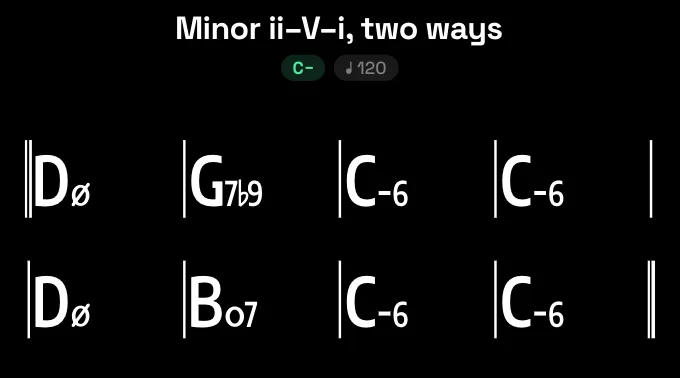
Its home is the ii of a minor key. In C minor, build a seventh chord on D with the scale's notes and you get D F A♭ C: Dm7♭5. The minor ii–V–i (the 2-5-1, also written ii-V-i), a bar (measure) each, is:
| Bar | 1 | 2 | 3 | 4 |
|---|---|---|---|---|
| Chord | Dm7♭5 | G7♭9 | Cm6 | Cm6 |
The A♭ in Dm7♭5 is the minor key's sixth degree, and it carries into the ♭9 of the G7 (more on that sound in altered chords). That is why the half-diminished chord sounds right before a dominant in minor and a plain Dm7 sounds a little too bright. More in the ii–V–I progression and the minor blues, which ends on one.
In a major key, the half-diminished chord sits on the seventh degree: Bm7♭5 in C (B D F A). It turns up in sequences such as Bm7♭5 E7 Am, which is the ii–V–i of the relative minor. It can also sit on the raised fourth degree: F♯m7♭5 in C, usually going to B7 (and on to Em), or down to Fmaj7 or C/G.
A useful equivalence: Cm7♭5 has the same notes as E♭m6 (E♭ G♭ B♭ C), and as A♭9 without its root. That gives you new voicings from shapes you already know; it also explains why the chord floats so well over a bass note a major third below.
How do you play m7b5 (m7♭5) and dim7 chords?
On guitar, two movable m7♭5 shapes play the chord in any key, and a dim7 shape sits beside them:
| Chord | Root on | Shape | Notes, low to high |
|---|---|---|---|
| Cm7♭5 | A string, 3rd fret | x3434x | C G♭ B♭ E♭ |
| Bm7♭5 | Low E string, 7th fret | 7x776x | B A D F |
| C°7 | A string, 3rd fret | x3424x | C G♭ A E♭ |
The dim7 shape differs from the m7♭5 shape by one finger: the B♭ on the G string drops a fret to A. Slide the dim7 shape up three frets and you have the same chord again.
On piano, with a bass player on the root, the left hand plays E♭ G♭ B♭ for Cm7♭5, or the inversion G♭ B♭ C E♭, which puts the root inside the chord. For C°7, the same with A in place of B♭: E♭ G♭ A, or G♭ A C E♭.
Where does the diminished seventh go?
The diminished seventh is a leading-tone chord. Each of its notes can slide a half step up or down into the next chord. Its classic job is vii°7 in a minor key: B°7 (B D F A♭) to Cm. Its notes are those of G7♭9 without the G, which is why it pulls to C so strongly.
In charts it shows up as a passing chord between two chords a whole step apart:
| Bar | 1 | 2 | 3 | 4 |
|---|---|---|---|---|
| Chord | Cmaj7 | C♯°7 | Dm7 | G7 |
C to C♯ to D in the bass, and the C♯°7 works like A7♭9 leading to Dm7. Because the chord is symmetrical, C♯°7, E°7, G°7 and B♭°7 are the same four notes in different order: there are only three diminished seventh chords in all. What dim means goes into its uses and that symmetry.
How do you tell them apart on a chart?
- ø vs °. The slash through the circle is the whole difference. On a faint photocopy or a phone screen it can disappear. If the chord sits right before a dominant, as the ii in minor, it is almost certainly ø.
- dim vs dim7. A bare "dim" or ° is, strictly, the triad; with the 7, it is the four-note chord. A writer who was careless with the 7 may mean either, so check the melody, or ask. Neither means m7♭5.
- Look at the next chord. Half-diminished goes to a dominant a fourth up (Dm7♭5 to G7). Diminished seventh goes to a chord a half step up from one of its notes (C♯°7 to Dm7, B°7 to Cm).
The triangle, circle and ø page covers the symbols themselves.
How do they sound, and what can a soloist play?
Half-diminished sounds dark but open, with the minor seventh softening the tense triad. The scale that fits it is Locrian (for Dm7♭5, the C minor scale from D: D E♭ F G A♭ B♭ C), or Locrian with a natural second (D E F G A♭ B♭ C) when the second should sound smoother.
The diminished seventh is more tense, and ambiguous: it does not commit to a key. The scale that fits it is the whole-half diminished, eight notes alternating whole and half steps from the root: for C°7, C D E♭ F G♭ A♭ A B. Or simply arpeggiate the chord, which already says everything.
Can you swap one for the other?
Not freely. In the minor ii–V–i, a D°7 in place of Dm7♭5 replaces the seventh, C, with B (C♭), which clashes with a melody on C and weakens the move to G7. A half-diminished chord in place of a passing dim7 loses the half-step pull into the next chord. If a chart is unclear, play the third and fifth (E♭ and G♭ in C), which both chords share, and listen to the band.
Gigplay's chord keyboard has separate keys for half-diminished (ø) and diminished (○), so a chart written in it keeps the two apart; how they are drawn, m7♭5 or ø, is set in Settings (Writing and editing a chart, Making it yours).