In a chord symbol, a small triangle (CΔ7, or just CΔ) means a major seventh chord, the same as Cmaj7: C E G B. A small circle (C°) means diminished: C E♭ G♭, and on most jazz charts the four-note C°7 (C E♭ G♭ B♭♭). A circle with a line through it (Cø) means half-diminished, the same as Cm7♭5: C E♭ G♭ B♭. And a minus sign (C−7) means minor, the same as Cm7.
These four marks are jazz shorthand, met on hand-written charts and in jazz fake books. Each one has a catch, which is what this page is about; the chord symbols chart has every other symbol.
The four symbols at a glance
| Symbol | Means | Same as | Notes in C |
|---|---|---|---|
| CΔ7, CΔ | Major seventh (CΔ alone: see below) | Cmaj7, CM7, Cma7 | C E G B |
| CΔ9 | Major ninth | Cmaj9 | C E G B D |
| C−Δ | Minor-major seventh | Cm(maj7) | C E♭ G B |
| C° | Diminished (triad, or seventh) | Cdim | C E♭ G♭ (C°7: + B♭♭) |
| C°7 | Diminished seventh | Cdim7 | C E♭ G♭ B♭♭ (A) |
| Cø, Cø7 | Half-diminished | Cm7♭5, C−7♭5 | C E♭ G♭ B♭ |
| C− | Minor | Cm, Cmin, Cmi | C E♭ G |
| C−7 | Minor seventh | Cm7, Cmin7 | C E♭ G B♭ |
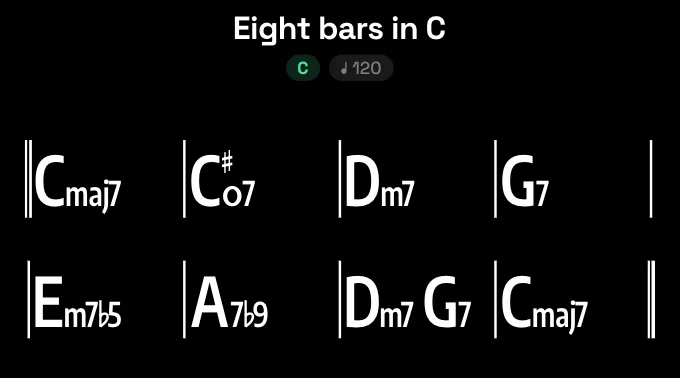
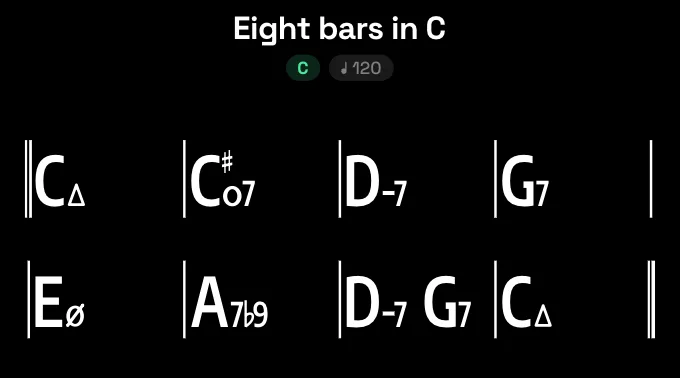
What does the triangle mean in chords?
The triangle is a major seventh: the seventh a half step under the root. CΔ is Cmaj7, FΔ is Fmaj7 (F A C E), B♭Δ is B♭maj7 (B♭ D F A).
Δ on its own is the one doubt: some writers use CΔ for Cmaj7, others for a plain C major chord. CΔ7 settles it, and CΔ9 is Cmaj9: with a number after it, the triangle brings in the major seventh, never the flat one. If in doubt, ask, or look at the melody: a B held over a bare CΔ points to the seventh chord.
The catch is handwriting. A quickly drawn Δ can look like an A, a 4 or a superscript "a". If a "CA" or "C4" turns up where a tonic chord should be, it is probably a triangle. More on what the major seventh does, and how it differs from a plain 7, in maj7 vs 7.
What does a circle mean in a chord?
A small raised circle means diminished: a stack of minor thirds. C° is C E♭ G♭.
The catch is whether the seventh is meant. C° normally means the three-note triad, and C°7 adds the diminished seventh, B♭♭ (played as A). But some jazz charts write C° and mean the four-note C°7. So on a jazz chart, check the melody and the chords around it: a passing C° between two chords a step apart works as C°7. On a pop chart, if the chord is the vii of the key (B° in C), play the triad, or check the melody before adding a seventh: the seventh the key gives that chord is A (Bm7♭5), not the A♭ of B°7, and the A♭ can clash with the tune.
A superscript o, or even a zero, means the same as °. More on how the chord works and where it goes in what dim means.
What does ø mean in chords?
The circle with a slash through it is half-diminished: a diminished triad with a minor seventh on top. Cø is C E♭ G♭ B♭, the same as Cm7♭5 or C−7♭5. Some write Cø7; the 7 is already implied, since a half-diminished chord always has its seventh.
The "half" is because only the triad is diminished. A full diminished seventh, C°7, has the seventh lowered once more, to B♭♭. So the slash through the circle is worth a semitone in the top note:
| Chord | Seventh | Notes |
|---|---|---|
| Cø (Cm7♭5) | B♭, minor seventh | C E♭ G♭ B♭ |
| C°7 (Cdim7) | B♭♭, diminished seventh | C E♭ G♭ B♭♭ |
The catch here is that on a small screen or a bad photocopy the line can vanish, turning ø into °. If the chord is the ii of a minor ii–V–i (2-5-1, ii-V-i), as in Dø G7 Cm, it is half-diminished. The half-diminished vs diminished page has both chords in every common context.
What does a minus sign mean in a chord?
Before anything else, a minus means minor: C− is Cm, C−7 is Cm7, C−6 is Cm6, C−Δ is the minor-major seventh. Its advantage: a lower-case m can be misread as a capital M, and a minus cannot.
The catch: on some charts, a minus in front of an alteration number means flat, not minor. C7−9 is C7♭9, and C−7−5 is Cm7♭5. Read where it sits. After the root, it is minor; in front of 5, 9 or 13, it is a flat. The minor seventh chords page has the whole family.
Where else do these symbols turn up?
In Roman numeral analysis, the same marks sit on numerals: vii° for the diminished chord on the seventh degree, viiø7 for the half-diminished one, and in jazz-style numerals IΔ or Imaj7 for the tonic. They mean exactly what they mean on letters. See Roman numeral analysis.
Should you write them on your own charts?
That depends on who reads them. Δ is used mainly in jazz, and popular music charts write maj instead: a jazz group will read Δ, °, ø and −, a pop band, a church team or a new dep may not. The words (maj7, dim, m7♭5, m) work for everyone. If you use the symbols, be consistent, and write C°7 rather than C° when you want the seventh.
Gigplay's chord keyboard has −, △, ø and ○ keys for minor, major seventh, half-diminished and diminished (Writing and editing a chart). How they are drawn is your choice: in Settings, Chords, Chord symbols, a Major seventh can be CΔ, Cmaj7, CM7 or Cma7, and a Minor C−, Cm, Cmin or Cmi, on every chart, whatever the chart says (Making it yours).