A chord symbol is read left to right in up to five parts: the root (a letter), the quality (major, minor, diminished, augmented, sus), the seventh, any extensions or alterations, and, after a slash, the bass note. So C7♭9/E is a C chord, major, with a minor seventh, a flattened ninth, and E in the bass. The chart below gives every common symbol with its notes in C; the sections after it explain the rules that let you read the ones you have never seen.
This is about the chord symbols written over a band chart or a lead sheet, bar by bar (measure by measure), not the fingering boxes guitar books call chord charts.
How do you read a chord symbol?
Take it apart in this order:
- Root. The letter, with ♭ or ♯ if it has one: C, B♭, F♯.
- Quality. Nothing means major. Then m (or min, mi, −) for minor, ° or dim for diminished, + or aug for augmented, sus for a suspended chord with no third.
- Seventh. A plain 7 means the minor seventh, a whole step below the root (B♭ in C). Maj7 (or M7, ma7, Δ) means the major seventh, a half step below (B). On a diminished chord, °7 is the diminished seventh, B♭♭.
- Extensions and alterations. 9, 11 and 13 stack further notes on top; ♭9, ♯9, ♯11, ♭13, ♭5 and ♯5 change one note; add puts in one note without the seventh.
- Bass. After a slash, the note the bass plays: C/E is a C chord over E.
Two rules do most of the work. First, a number above 7 (9, 11, 13) includes the seventh: C9 has B♭ in it, Cadd9 does not. Second, 7 on its own is the flat (minor) seventh; only maj, M or Δ makes it major (the one exception is °7, the diminished seventh). That is the whole difference between Cmaj7 and C7.
The chord symbols chart: what does each symbol mean?
Every chord here is on C. Move the whole pattern to any root and the symbol means the same thing.
| Symbol | Also written | Name | Notes |
|---|---|---|---|
| C | CM, Cmaj | Major | C E G |
| Cm | Cmin, Cmi, C− | Minor | C E♭ G |
| C° | Cdim | Diminished | C E♭ G♭ |
| C+ | Caug, C(♯5) | Augmented | C E G♯ |
| Csus4 | Csus | Suspended fourth | C F G |
| Csus2 | Suspended second | C D G | |
| C5 | Power chord (no third) | C G | |
| C6 | Major sixth | C E G A | |
| Cm6 | C−6 | Minor sixth | C E♭ G A |
| C6/9 | C69 | Six-nine | C E G A D |
| Cm6/9 | Cm69 | Minor six-nine | C E♭ G A D |
| Cadd9 | C(add9), C2 (see below) | Added ninth | C E G D |
| C7 | Dominant seventh | C E G B♭ | |
| Cmaj7 | CM7, Cma7, CΔ | Major seventh | C E G B |
| Cm7 | Cmin7, C−7 | Minor seventh | C E♭ G B♭ |
| Cm(maj7) | C−Δ, CmM7 | Minor-major seventh | C E♭ G B |
| Cm7♭5 | Cø, C−7♭5 | Half-diminished | C E♭ G♭ B♭ |
| C°7 | Cdim7 | Diminished seventh | C E♭ G♭ B♭♭ (A) |
| C7sus4 | C7sus | Dominant seventh, suspended | C F G B♭ |
| C9sus4 | B♭/C | Ninth, suspended | C F G B♭ D |
| C+7 | C7♯5, C7+5 | Augmented seventh | C E G♯ B♭ |
| C9 | Dominant ninth | C E G B♭ D | |
| Cmaj9 | CΔ9 | Major ninth | C E G B D |
| Cm9 | C−9 | Minor ninth | C E♭ G B♭ D |
| Cmaj7♯11 | CΔ♯11 | Major seventh, sharp eleven | C E G B (D) F♯ |
| Cm11 | C−11 | Minor eleventh | C E♭ G B♭ D F |
| C11 | Eleventh | C G B♭ D F (third left out) | |
| C13 | Thirteenth | C E G B♭ D A (eleventh left out) | |
| C7♭9 | C7(♭9), C7−9 | Seventh, flat nine | C E G B♭ D♭ |
| C7♯9 | C7(♯9), C7+9 | Seventh, sharp nine | C E G B♭ D♯ |
| C7♭5 | C7(♭5) | Seventh, flat five | C E G♭ B♭ |
| C7♯11 | C7(♯11) | Seventh, sharp eleven | C E G B♭ F♯ |
| C7♭13 | C7(♭13) | Seventh, flat thirteen | C E G B♭ A♭ |
| C7alt | Calt | Altered dominant | C E B♭ with ♭9, ♯9, ♭5 or ♯5 |
| C/E | C over E (slash chord) | E in the bass, C E G above |
Three families are easy to misread: half-diminished chords (m7♭5 is not m7, and not °7), add chords (add9 is not 9) and altered chords (alt rules out the natural fifth and ninth). For the bass after the slash, see slash chords.
What does + mean in chords?
On its own after the root, + means augmented: the fifth raised a half step. C+ is C E G♯. With a seventh, C+7 and C7+ both mean C E G♯ B♭, the same as C7♯5.
The trouble starts when + sits in front of a number other than the fifth. Some charts use + and − for ♯ and ♭ on alterations: C7+9 is C7♯9, C7−9 is C7♭9. So a − right after the letter means minor (C−7), and a − in front of an alteration number means flat (C7−9). Read the position, not just the sign. If you write charts yourself, use ♯ and ♭ for alterations and keep + and − for augmented and minor, or avoid them altogether.
What do the triangle, circle and slashed circle mean?
They are shorthand: Δ for major seventh, ° for diminished, ø for half-diminished (m7♭5), and − for minor. The triangle, circle and ø each have a catch: the circle alone may mean a triad or a seventh chord, depending on who wrote it.
Why are there so many ways to write the same chord?
Because chord symbols have no single standard: writers, publishers and books each keep their own habits. Cmaj7, CM7, Cma7 and CΔ all mean the same four notes, and you will meet all four.
A few spellings cause real mistakes on the bandstand:
- CM7 and Cm7. A capital M for major and a small m for minor look alike in handwriting and in some fonts. Maj7 and m7 cannot be confused.
- C°. On some charts it means C°7, on others the triad. If it matters, write the 7.
- C2. Some charts use 2 for an added second with the third kept (Cadd9 played close); others mean Csus2. Ask.
- C−. The dash is easy to miss, and a reader who misses it plays C major.
When you write chord symbols for other people, pick one spelling for each kind of chord and keep it through the whole chart.
What are the numbers and brackets for?
The numbers count up the major scale of the root: in C, 2 is D, 4 is F, 6 is A, 9 is D an octave up, 11 is F, 13 is A. There is one exception: a 7 means B♭ unless the symbol says maj. A 9 and a 2 are the same note; the 9 tells you a seventh is there too, unless it says add, and that the note sits high in the chord. 9th, 11th and 13th chords explains how the numbers stack, and which notes players leave out.
Brackets hold a change or an extra note so it does not run into the rest: C7(♭9), C(add9), Cm(maj7). Cm(maj7) needs them, or it could be read as "Cmmaj7". Some charts stack the alterations in a little column inside one bracket, C7(♭9 ♯11); read them all, they all apply. Less often you will see no3 or omit3, which takes a note out: C(no3) is C G, the same as C5.
What should you play if you can't read the symbol in time?
On a gig, at speed, read the root and the quality and keep going. The root and the third (major or minor) carry most of what the band needs; the seventh comes next. A pianist who sees C7♯9♭13 and plays C7 has not ruined anything; one who plays C major over a Cm7 has. The root, the third and the seventh are the harmony; the rest is colour.
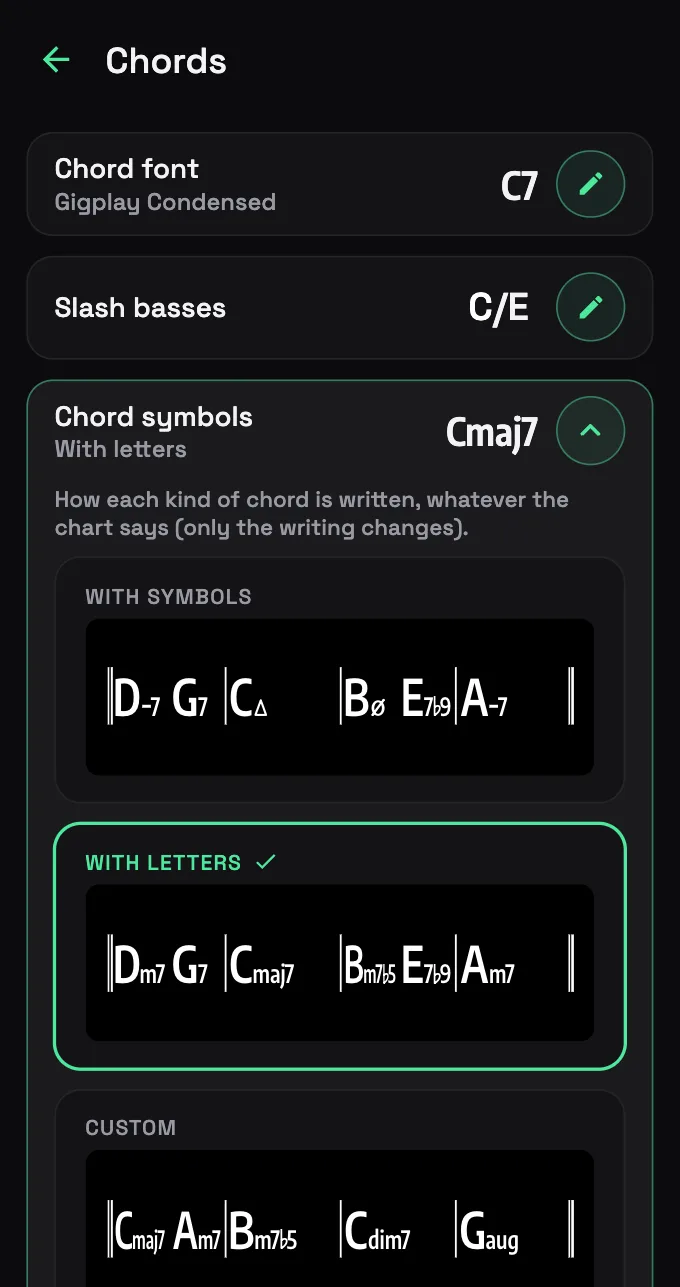
In Gigplay, Settings, Chords, Chord symbols chooses how each kind of chord is written on every chart: a Major seventh as CΔ, Cmaj7, CM7 or Cma7, a Minor as C−, Cm, Cmin or Cmi. Only the writing changes, never the chord (see Making it yours).