

A ii–V–I (said "two-five-one", also written 2-5-1 or ii-V-I) is three chords built on the second, fifth and first notes of a key. In C major it is Dm7 – G7 – Cmaj7; in C minor, Dm7♭5 – G7♭9 – Cm6. It is extremely common in jazz, and turns up in R&B, pop, rock and country too. A ii–V can also point at a new key, even for a bar (measure).
What are the chords of a ii–V–I?
Build a seventh chord on each note of the C major scale and you get Cmaj7, Dm7, Em7, Fmaj7, G7, Am7 and Bm7♭5. The ii–V–I takes the second, the fifth and the first:
| Degree | Chord in C | Notes | Type |
|---|---|---|---|
| ii | Dm7 | D F A C | minor seventh |
| V | G7 | G B D F | dominant seventh |
| I | Cmaj7 | C E G B | major seventh |
So in any major key the recipe is the same: a minor seventh, a dominant seventh a fourth higher, and a major seventh a fourth higher again. C6 or plain C can stand in for Cmaj7, and the V can take colours (G9, G13, G7♭9) without changing what the progression does.
Why does a 2-5-1 sound so final?
Two things happen at once.
- The roots move down in fifths: D to G to C. Each root is a fifth above the next, and a root falling a fifth is the strongest pull in tonal harmony. More on that in circle of fifths progressions.
- The guide tones move by half steps or stay put. The guide tones are each chord's 3rd and 7th. Dm7's C falls to B, the 3rd of G7; its F stays and becomes G7's 7th. Then G7's F falls to E, the 3rd of Cmaj7, and its B stays as Cmaj7's 7th.
| Chord | 3rd | 7th |
|---|---|---|
| Dm7 | F | C |
| G7 | B | F |
| Cmaj7 | E | B |
The tritone inside G7 (B and F) is the tension; its resolution to C and E (or B and E) is the release.
The ii–V–I in all 12 major keys (2-5-1 in every key)
| Key | ii | V | I |
|---|---|---|---|
| C | Dm7 | G7 | Cmaj7 |
| D♭ | E♭m7 | A♭7 | D♭maj7 |
| D | Em7 | A7 | Dmaj7 |
| E♭ | Fm7 | B♭7 | E♭maj7 |
| E | F♯m7 | B7 | Emaj7 |
| F | Gm7 | C7 | Fmaj7 |
| G♭ | A♭m7 | D♭7 | G♭maj7 |
| G | Am7 | D7 | Gmaj7 |
| A♭ | B♭m7 | E♭7 | A♭maj7 |
| A | Bm7 | E7 | Amaj7 |
| B♭ | Cm7 | F7 | B♭maj7 |
| B | C♯m7 | F♯7 | Bmaj7 |
The spelling matters: in A♭ the V is E♭7, never D♯7, because each chord is spelled from the key it belongs to. Spell the chords from the key and they read at a glance.
What is a minor ii–V–i?
In a minor key the chords come mostly from harmonic minor, the minor scale with a raised 7th. On its second note you get a half-diminished chord, m7♭5; on its fifth, a dominant seventh, usually with a ♭9; on the first, a minor chord.
In C minor: Dm7♭5 (D F A♭ C) – G7♭9 (G B D F A♭) – Cm6 or Cm7. The A♭ that flattens the ii's fifth is the 6th of C minor, and the same A♭ is the ♭9 of the V, so the colour runs through the ii and the V. On a Cm6 (C E♭ G A) it then rises to A, the brighter "jazz minor" colour; a Cm7, or a melody that keeps the A♭, holds on to it. The B in G7 is the raised 7th that leads up to C. If m7♭5 is new to you, see half-diminished chords.
| Key | ii | V | i |
|---|---|---|---|
| C minor | Dm7♭5 | G7♭9 | Cm6 |
| C♯ minor | D♯m7♭5 | G♯7♭9 | C♯m6 |
| D minor | Em7♭5 | A7♭9 | Dm6 |
| E♭ minor | Fm7♭5 | B♭7♭9 | E♭m6 |
| E minor | F♯m7♭5 | B7♭9 | Em6 |
| F minor | Gm7♭5 | C7♭9 | Fm6 |
| F♯ minor | G♯m7♭5 | C♯7♭9 | F♯m6 |
| G minor | Am7♭5 | D7♭9 | Gm6 |
| G♯ minor | A♯m7♭5 | D♯7♭9 | G♯m6 |
| A minor | Bm7♭5 | E7♭9 | Am6 |
| B♭ minor | Cm7♭5 | F7♭9 | B♭m6 |
| B minor | C♯m7♭5 | F♯7♭9 | Bm6 |
The tonic of a minor ii–V–i is written several ways: Cm6 and Cm(maj7) sound settled and "jazz minor", Cm7 sounds darker and more modal. A chart may also write the V as G7alt or G7♯9; it is the same chord doing the same job, with more tension.
What scales fit a ii–V–I?
| Chord | Major ii–V–I (in C) | Minor ii–V–i (in C minor) |
|---|---|---|
| ii | D Dorian | D Locrian (or Locrian ♮2) |
| V | G Mixolydian | G altered, or C harmonic minor from G |
| I | C major (Ionian) | C melodic minor, or C Dorian |
In the major ii–V–I, the three scales are one scale: D Dorian, G Mixolydian and C major are all the white notes, started from a different place. So the scale doesn't change; what changes is which notes you land on, and those are the guide tones in the table above. The minor ii–V–i really does change scales, chord by chord, and that is why it takes longer to sound good.
For comping, start with shell voicings, the root with the 3rd and 7th: D–F–C for Dm7, G–F–B for G7, C–E–B for Cmaj7. On guitar they sit on three strings; on piano, the left hand plays them while the right adds colours or the melody.
How is a ii–V–I written on a chart?
On a band chart (bars of chord symbols, not guitar fret diagrams) you will meet it in three common shapes:
| Shape | Bar 1 | Bar 2 | Bar 3 | Bar 4 |
|---|---|---|---|---|
| One bar each | Dm7 | G7 | Cmaj7 | Cmaj7 |
| Short ii–V | Dm7 G7 | Cmaj7 | Cmaj7 | Cmaj7 |
| Long ii–V (I in bar 5) | Dm7 | Dm7 | G7 | G7 |
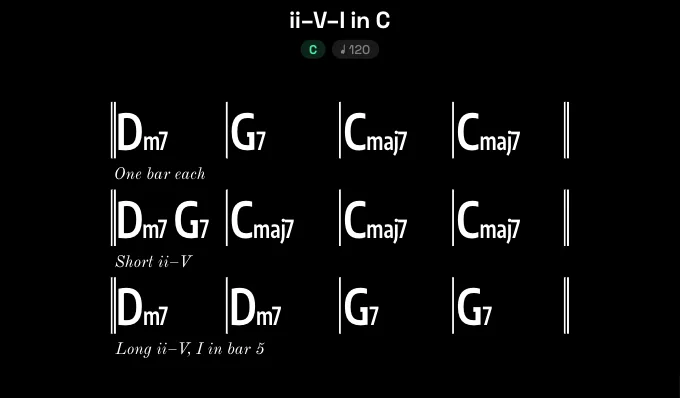
In the short ii–V each chord lasts two beats; in the long one, two bars, so at a fast tempo the change comes more calmly.
It also appears as numbers. Jazz writers use capital numerals with the chord quality (IIm7 – V7 – Imaj7); classical analysis shows the quality by case (ii7 – V7 – I7, with "I7" meaning the seventh above the root, whatever its kind). The Nashville number system writes 2m7 – 5 – 1 (or 2-7 5 1, the dash meaning minor), adding a 7 to the 5 when the dominant seventh matters. None of them is wrong: see Roman numerals vs Nashville numbers.
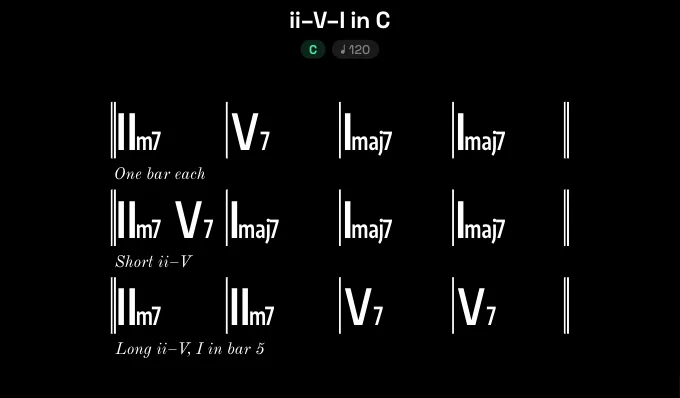
In Gigplay, Chords as shows any chart as Jazz degrees, Classical degrees or Nashville numbers, counted from the song's key, so every ii–V–I in a tune shows up as the same three symbols (Reading a song).
Where does a ii–V go if not to I?
A ii–V need not lead to the home key: it can point at a chord for a moment and move on.
- To another chord of the key. In C, Gm7 – C7 leads to Fmaj7, and Em7 – A7 leads to Dm7. The V of these is a secondary dominant.
- In chains. Em7 – A7 – Dm7 – G7 – Cmaj7: each minor chord is the ii of a new ii–V, and the roots keep falling in fifths.
- Stepping down. Dm7 – G7 – Cm7 – F7 – B♭maj7: the same shape, a whole step lower each time.
- With a tritone substitute. Dm7 – D♭7 – Cmaj7 puts the bass on a chromatic slide. See tritone substitution.
When reading a new tune, look for the pattern "minor seventh, then a dominant seventh a fourth up". Bracket each one and the chart shrinks to a handful of key centres.
How do you practice ii–V–Is?
- Guide tones first. Play only the 3rds and 7ths with your left hand (or on two strings), one chord per bar, until the half-step movement is in your fingers.
- Take it round the keys. Either round the circle of fifths (C, F, B♭, E♭…) or down in whole steps (C, B♭, A♭… then B, A, G…). Both reach all 12 keys; how to practice in all 12 keys has more ways.
- Do the minor ones as well. They change scale chord by chord, and take more hours.
- Play with a rhythm section. Write the four bars once, loop them and let the key change on each pass.
In Gigplay, write the ii–V–I as a four-bar song and open the Player. Under More options, Key change moves it up a half step, a whole step or a fourth each time through, so the band takes you through the keys while you play (The band).