

A great many songs are built from a handful of progressions, and the best known of them use the same four chords of a major key: I, IV, V and vi. They are I–V–vi–IV (1-5-6-4: C – G – Am – F in C), I–vi–IV–V (C – Am – F – G), the three-chord I–IV–V, and in jazz the ii–V–I (Dm7 – G7 – Cmaj7). Learn them by number rather than by letter and you know them in every key at once.
What are the most common chord progressions?
All shown in C and in G:
| Progression | Numbers | In C | In G | Where you hear it |
|---|---|---|---|---|
| I–V–vi–IV (the "axis" progression) | 1-5-6-4 | C G Am F | G D Em C | popular music of many kinds |
| vi–IV–I–V | 6-4-1-5 | Am F C G | Em C G D | the same loop, starting on the minor |
| I–vi–IV–V (the "50s" or "doo-wop" progression) | 1-6-4-5 | C Am F G | G Em C D | 1950s and early 1960s pop, doo-wop |
| I–IV–V | 1-4-5 | C F G | G C D | the three chords of the 12-bar blues |
| I–IV–vi–V | 1-4-6-5 | C F Am G | G C Em D | the IV and vi of 1-6-4-5 swapped |
| ii–V–I | 2-5-1 | Dm7 G7 Cmaj7 | Am7 D7 Gmaj7 | jazz |
| I–vi–ii–V | 1-6-2-5 | C Am Dm G | G Em Am D | the jazz turnaround, standards |
| IV–V–iii–vi | 4-5-3-6 | Fmaj7 G7 Em7 Am | Cmaj7 D7 Bm7 Em | Japanese pop (the "royal road"), here with its 7ths |
| I–V–vi–iii–IV–I–IV–V (the "Pachelbel progression") | 1-5-6-3-4-1-4-5 | C G Am Em F C F G | G D Em Bm C G C D | Pachelbel's Canon |
| 12-bar blues | 1-1-1-1-4-4-1-1-5-4-1-5 | C7 … F7 … G7 | G7 … C7 … D7 | blues, rock and roll |
Three more that sit outside the major key are worth knowing: the minor-key i–♭VII–♭VI–V (the Andalusian cadence, Am G F E), the Mixolydian I–♭VII–IV (C B♭ F), and the 12-bar blues in all its versions.
Why do the same chords keep coming back?
In a major key, the I, IV and V triads between them contain every note of the scale: C E G, F A C, G B D. So any melody in the key fits over one of them, and three chords are enough to harmonise a tune. The vi (A C E) is the relative minor, sharing two notes with the I: it gives the same key a sadder colour without leaving it.
The order matters too. V to I is the strongest resolution; IV to I is softer (the "amen" ending); vi to IV and I to vi are gentle moves where two notes stay put. I–V–vi–IV uses all of them in a loop that never quite closes, which is why it can repeat for a whole song.
I–V–vi–IV in every key
The four-chord loop, written as a chart reads it, one chord per bar (measure):
| Key | I | V | vi | IV |
|---|---|---|---|---|
| C | C | G | Am | F |
| D♭ | D♭ | A♭ | B♭m | G♭ |
| D | D | A | Bm | G |
| E♭ | E♭ | B♭ | Cm | A♭ |
| E | E | B | C♯m | A |
| F | F | C | Dm | B♭ |
| G♭ | G♭ | D♭ | E♭m | C♭ (often written B) |
| G | G | D | Em | C |
| A♭ | A♭ | E♭ | Fm | D♭ |
| A | A | E | F♯m | D |
| B♭ | B♭ | F | Gm | E♭ |
| B | B | F♯ | G♯m | E |
Start the loop on the vi and you get vi–IV–I–V (Am F C G): the same four chords, a darker first impression. Start on the IV and you get IV–I–V–vi. A song can use one order in the verse and another in the chorus.
Here is how that looks on a band chart, for a song written for this article in G: a verse on vi–IV–I–V, a chorus on I–V–vi–IV, and the last bar of the chorus held on the IV before going back.
Verse:   | Em  | C   | G   | D   |
         | Em  | C   | G   | D   |
Chorus:  | G   | D   | Em  | C   |
         | G   | D   | Em  | C   | C   |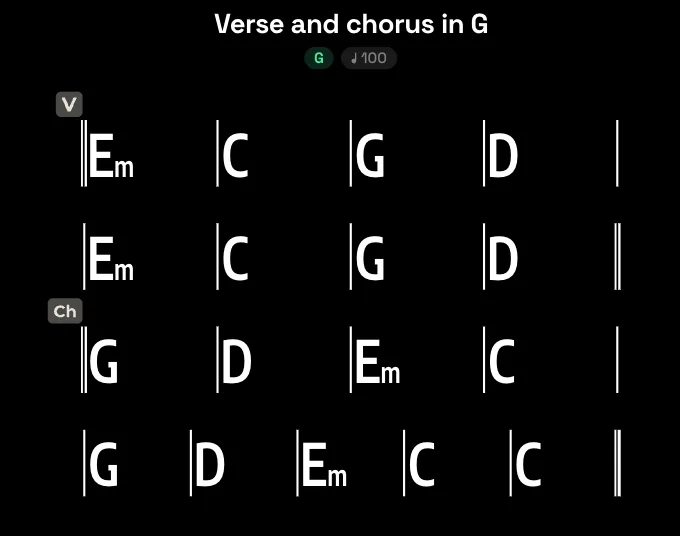
Two loops, four chords, and the change of starting point is what tells the listener the chorus has arrived.
How do you write progressions as numbers?
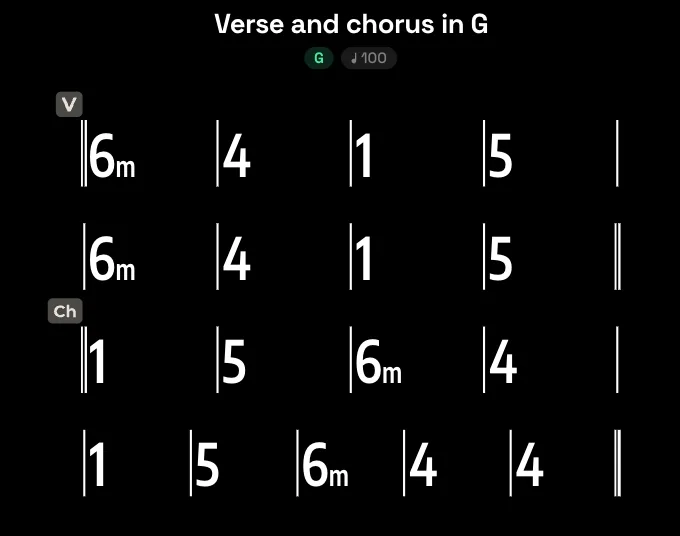
Writing chords as numbers means you can play them in any key on the spot, which is why session musicians in Nashville developed a system for it in the late 1950s. In Roman numerals it is already I–V–vi–IV, lower case meaning minor; in the Nashville number system it is 1 5 6m 4 (or 1 5 6- 4).
In Gigplay, Chords as shows any chart as Nashville numbers, Jazz or Classical degrees, counted from the song's key (Reading a song). A chart in letters becomes a chart of 1-5-6-4s you can read in any key.
How do you make a common progression your own?
The progression is only the skeleton. What makes two songs on the same chords sound different:
- Harmonic rhythm. One chord per bar, two per bar, or the vi and IV held for two bars each.
- Inversions and bass lines. C – G/B – Am – F walks the bass down C, B, A.
- Sevenths and colours. Cmaj7 – G – Am7 – Fmaj7 sounds softer and jazzier; Csus2 – G – Am – Fadd9 sounds open and modern.
- A borrowed chord. Replace the IV with a minor iv on the last pass (C G Am Fm) or end on ♭VI – ♭VII – I. More in borrowed chords.
- The groove and the key. The same four chords as a slow ballad in E♭ and a fast punk song in E feel like different worlds.
How do you learn to hear them?
Play each progression in the table, by number, in three or four keys, and sing the bass notes as you go. Then put on any song in a style you play and try to name the progression by ear: listen to the bass, which often tells you whether you are hearing 1-5-6-4, 1-6-4-5 or 6-4-1-5.
To see which of your songs share a progression, Gigplay's Search a progression (under Smart lists) finds them in any key, typed as notes (C G Am F) or as degrees (Playlists and your library).