Write a chord symbol as its root, then its quality, then its highest extension, then any altered notes, then a bass note after a slash: C, Cm7, Cmaj9, C7♭9, Cm7/B♭. Use one spelling for each kind of chord through the whole chart, flat and sharp signs (not + and −) for altered notes, and the root spelled for the key. There is no official standard chord symbol notation, but a chart written this way leaves a reader little to guess, whatever style they play. The details below are the choices that cause wrong chords on gigs, and how to make them.
What order do the parts of a chord symbol go in?
Always the same five, left to right, each one only if needed:
| Part | Examples | Says |
|---|---|---|
| Root | C, F♯, B♭ | the chord's name note |
| Quality | m, maj, °, +, sus | minor or major third, diminished, augmented, suspended |
| Extension | 6, 7, 9, 11, 13 | the highest added note; 7, 9, 11, 13 include the seventh |
| Alterations | ♭5, ♯5, ♭9, ♯9, ♯11, ♭13 | notes raised or lowered from the usual |
| Bass | /E, /B♭ | the bass note, when it is not the root |
So Cm9 is a minor chord with a seventh and a ninth; C13♯11 is a dominant thirteenth with a raised eleventh; Cm7/B♭ is C minor seven with B♭ in the bass. The chord symbols cheat sheet gives the notes of every one.
Is there a standard chord symbol notation?
Not an official one, but there is a reference: Carl Brandt and Clinton Roemer's book Standardized Chord Symbol Notation (1976), the system Clinton Roemer, a copyist, worked out in the early 1970s. Two of its recommendations:
- Letters, not signs, for the quality: MA and MI, as in CMA7 and CMI7 (also printed Cma7 and Cmi7), with MA only where it marks a major seventh (CMA7, CMA9), never on a plain major triad.
- Parentheses around alterations, so they read as one group: C7(♭9).
Publishers and arrangers each have house styles, and triangles and minus signs are still seen on charts. This page follows the same spirit with m and maj7. What matters on any one chart is consistency.
Which way should each chord be written?
The left column is the plainest choice, the one the fewest readers will get wrong; the middle column is what you will also see, and should be able to read:
| Chord | Write | Also seen | Notes in C |
|---|---|---|---|
| Major | C | CM, Cmaj | C E G |
| Minor | Cm | Cmin, Cmi, C− | C E♭ G |
| Dominant seventh | C7 | Cdom7 | C E G B♭ |
| Major seventh | Cmaj7 | CΔ, CΔ7, CM7, Cma7 | C E G B |
| Minor seventh | Cm7 | C−7, Cmin7, Cmi7 | C E♭ G B♭ |
| Half-diminished | Cm7♭5 | Cø, Cø7, Cmi7(♭5) | C E♭ G♭ B♭ |
| Diminished seventh | C°7 | Cdim7, Cdim | C E♭ G♭ B♭♭ |
| Augmented | C+ | Caug, C(♯5) | C E G♯ |
| Suspended fourth | Csus4 | Csus | C F G |
| Suspended second | Csus2 | C2 | C D G |
| Added ninth | Cadd9 | C(add9), C2 | C E G D |
| Sixth | C6 | C E G A | |
| Six-nine | C6/9 | C69 | C E G A D |
| Minor, major seventh | Cm(maj7) | C−Δ7, CmMaj7 | C E♭ G B |
The 6/9 is the one slash in a chord symbol that is not a bass note. To keep it from being read as C6 over a D bass, some writers write C6(9) or stack the 6 above the 9.
Triangles, circles and minus signs are quick to write by hand, but not every reader knows them, and the triangle is ambiguous: some writers mean a major triad by it, others a major seventh. If the chart is for a mixed band, the letters are safer. What the triangle, circle and ø mean explains the signs for anyone who meets them.
Should you write m or −, maj7 or Δ?
Either works, but choose once. The trouble is mixing them, and one specific confusion:
- M and m. CM7 (major seventh) and Cm7 (minor seventh) differ only by a capital letter. In handwriting, or a small font on a dim stage, they look alike, and the two chords sound very different (maj7 vs 7 shows how). Write maj7 for the major seventh and m for minor, and the risk is gone.
- Minus for minor, minus for flat. If you write C−7 for C minor seven, never also write C7−9 for a flat ninth. Use ♭9.
- A small circle. C° on its own is, strictly, the diminished triad, but a writer careless with the 7 may mean the seventh chord. Write C°7 for the four-note chord and C° only for the triad, and nobody has to guess.
What does a number alone mean?
This is where many misreadings start.
- C7 is a dominant seventh: major third, flat seventh. It is not a major seventh.
- C9, C11, C13 are dominant chords too, with the seventh included: C9 is C E G B♭ D. For a major chord with a ninth, write Cmaj9.
- C6 has a sixth and no seventh.
- Cadd9 is a major triad with a ninth and no seventh. Writing C9 when you mean Cadd9 puts a B♭ in the chord that should not be there. Add9 vs 9 vs sus2 goes through the difference.
- C2 means Csus2 to some players and Cadd9 to others. Write the one you mean.
- C5 is a power chord: root and fifth, no third.
How do you write altered notes (b9, #9, #11)?
With ♭ and ♯ before the number: C7♭9, C7♯9, C7♯11, C7♭13, Cm7♭5. On a keyboard where those signs are hard to type, "b" and "#" are read the same way: C7b9, C7#9, C7#11, Cm7b5.
When there are two or more alterations, write them from the lowest to the highest number, and use parentheses if they might run together: C7(♭9♯11). For a dominant where the writer wants altered tensions but leaves the choice to the player (♭9, ♯9, ♭5, ♯5 in any mix), write C7alt. Altered chords covers what "alt" lets the player choose.
Avoid + and − for alterations. C7+9 might be read as an augmented chord with a ninth, and C7-5 as a minor chord.
How do you write a bass note?
After a slash: C/E is a C major chord with E in the bass; Cm7/B♭ is C minor seven over its seventh. The bass player plays the note after the slash, the others play the chord before it. Slash chords explains inversions and pedal basses.
A chord over a bass note that is not in the chord is written the same way: D/C is D major over a C bass. Some arrangers write one chord above another with a horizontal line between them (a polychord) to mean two chords stacked; never use a slash for that, since every reader will take the lower one as a bass note.
How should the roots be spelled?
By the key, so that the chart reads as harmony and not as a list of piano keys. In D major, the iii chord is F♯m, not G♭m. In A♭ major, the IV chord is D♭, not C♯. A bass line walking down from C in C major is spelled with flats: C, C/B♭, F/A, Fm/A♭, not C/A♯ and Fm/G♯.
When a song moves into sharp keys and back, spell each passage in the key it is in at the time, even if it means writing G♯ in one bar and A♭ ten bars later.
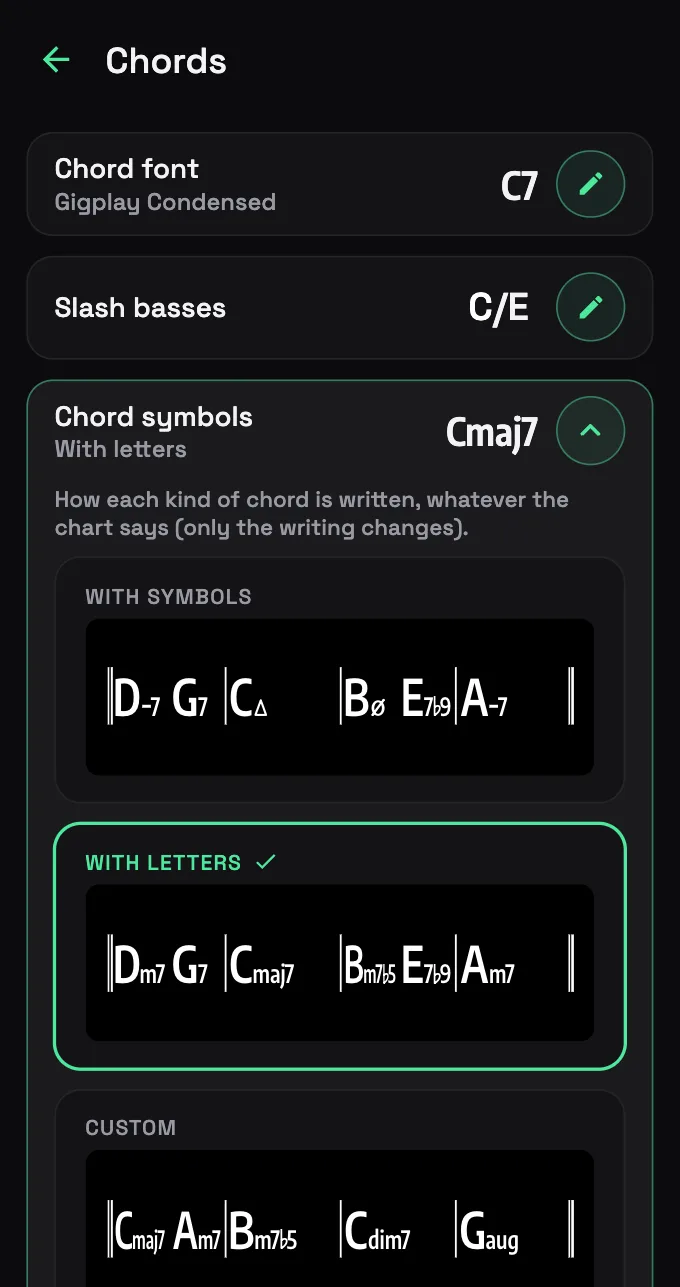
In Gigplay, the chords on a chart are stored as chords, not as text, so how they are written is a setting: Settings, Chords, Chord symbols lets you show a Major seventh as CΔ, Cmaj7, CM7 or Cma7, a Minor as C−, Cm, Cmin or Cmi, and so on for each kind. Only the writing changes, never the chord (see Making it yours).