
To write a chord chart, work out the song's form first, then set it out bar by bar (measure by measure), four bars to a line, one section after another, with the key, tempo and feel at the top. Write one chord symbol for each change, in the bar where it happens, mark the sections with letters or names, and add only the signs the band needs to get round the song: repeats, endings, hits, stops. This is the band chart a rhythm section reads on a gig, not the fingering diagram of a guitar chord that "chord chart" often brings up. A good one can be played at sight by a musician who has never heard the song.
What should you work out before writing anything?
The form. Listen through (or think through, if it is your own song) and write the sections in order with their length in bars:
- Intro: 4 bars
- Verse: 8 bars
- Chorus: 8 bars
- Verse, Chorus
- Bridge: 8 bars
- Chorus twice, the last time with a 2-bar tag
If a section comes out at 7 or 9 bars, count again and look for a bar of 2/4, a held chord or a miscount; if it really is 7 or 9, write it that way. Once the list is right, the chart is mostly a matter of filling in boxes.
What goes at the top of the chart?
Everything someone needs before the count-in, on one or two lines:
- Title, and the composer if it is needed.
- Key, written out ("Key: G"), even if the first chord gives it away. Write the chart in concert pitch unless it is a part for one transposing instrument, and say so if it is.
- Time signature at the start of the first line.
- Tempo and feel: a metronome mark (♩ = 96) and a word or two: "straight eighths, half-time chorus", "medium swing", "bossa". The feel tells a rhythm section what to play with the chords.
- A road map in a line, if the form is long or unusual: "Intro – V – Ch – V – Ch – Br – Ch ×2 – Tag".
How do you lay out the bars?
Write four bars to a line (a chord chart template gives ready grids). Phrases of 4 and 8 bars then line up: an 8-bar verse is two lines and a 16-bar chorus is four, so the shape of the song is visible at a glance and a player can find "the second line of the chorus" without counting.
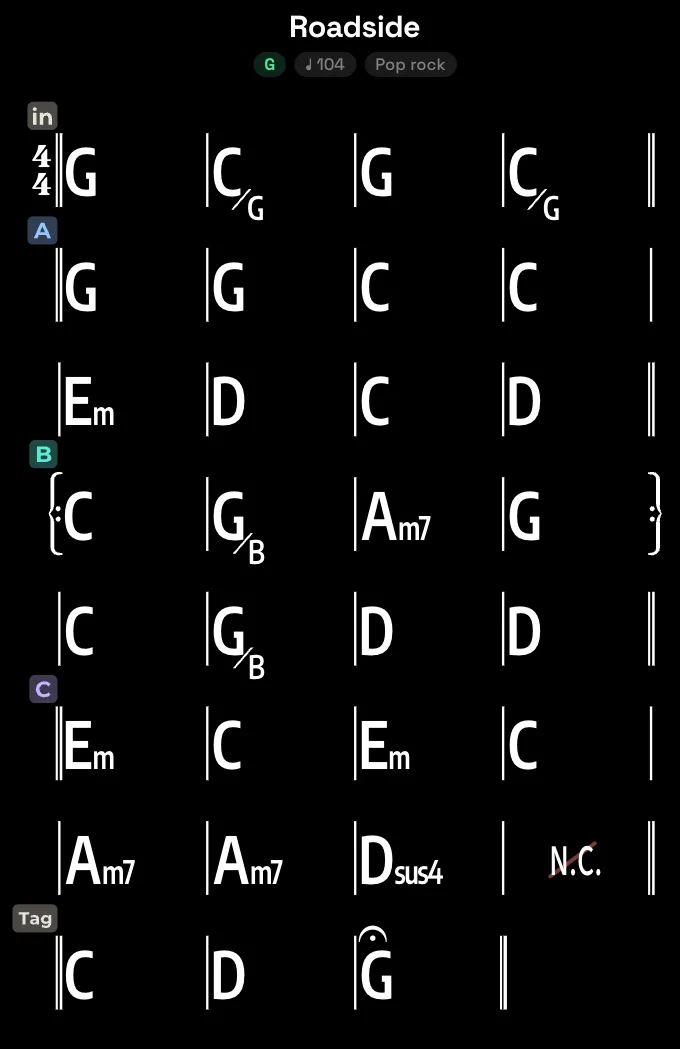
Start every section on a new line, with its letter or name at the start, and end it with a double barline. Here is a complete chart for a song written for this article, a medium rock tune in G, as it would be typed:
ROADSIDE
Key: G    4/4    ♩ = 104    Straight eighths, medium rock
Road map: Intro – A – B – A – B – C – B – Tag

Intro  |  G       |  C/G     |  G       |  C/G     ||
A      |  G       |  G       |  C       |  C       |
       |  Em      |  D       |  C       |  D       ||
B      |: C       |  G/B     |  Am7     |  G      :|  2x
       |  C       |  G/B     |  D       |  D       ||
C      |  Em      |  C       |  Em      |  C       |
       |  Am7     |  Am7     |  Dsus4   |  N.C.    ||
Tag    |  C       |  D       |  G (hit on 1, let ring)   ||
Read across: one chord a bar, four bars a line, a double barline at the end of each section. The chorus (B) plays its first line twice, then its second line. The bridge (C) ends with a bar of N.C., where the band stops before the last chorus, and the tag ends on one hit.
Where a section is shorter than four bars (a 2-bar tag, a 6-bar phrase), leave the rest of the line empty rather than starting the next section in it. The eye relies on sections starting at the left margin.
How do you show more than one chord in a bar?
The bar is the unit. The rules:
| Written in a bar of 4/4 | Played |
|---|---|
| G | G for four beats |
| G C | two beats each |
| G / / C | G for three beats, C on beat 4 |
| G / C D | G for two beats, then C and D a beat each |
| G C D Em | one beat each |
Slashes stand for beats, so use them whenever two chords do not split the bar evenly. In 3/4, two chords in a bar are ambiguous (two beats and one, or one and two?), so always write the slashes there. Slash notation covers the rhythm slashes in full.
Which chord symbols should you use?
The plainest ones that say exactly what you mean, written the same way all the way through. Pick one spelling for each kind of chord and stick to it: Cmaj7 (not CM7, which is too close to Cm7), and Cm7 or Cmin7, but not both on one page. Spell the chords in the key: in F the IV chord is B♭, not A♯; in E the iii chord is G♯m, not A♭m. Use a slash chord (G/B) when the bass note matters to the sound, as it does in a descending bass line; leave it off when it does not.
How to write chord symbols everyone reads the same goes through the choices one by one: m or a minus sign, maj7 or a triangle, when to use "add", how to write altered chords. For a band that changes key often, a Nashville number chart writes the same chart as numbers.
How do you show repeats, endings and the order of sections?
Write the song in the order it is played, using repeats where they make the chart shorter without making it harder to follow.
- Repeat barlines for a section played twice in a row. Add "2x" or "3x" over the end barline if it goes round more than twice.
- First and second endings when the repeat is identical except for its last bar or two.
- D.S. al Coda when the end of the song goes back to an earlier section and then jumps to an ending. It saves a page, but every jump is a chance to get lost, so use it only when the chart would otherwise run onto a second page.
- % (the bar repeat sign) for a bar the same as the one before. Avoid long runs of them: four % signs in a row are harder to count than four written chords.
If a second verse differs from the first by one chord, write the verse out twice. A chart is read at speed; one extra line costs nothing, a missed exception costs a bar of wrong chords.
How do you write hits, stops and changes of feel?
Anything the whole band does together goes on the chart, in the bar where it happens:
- Hits (the band accents a rhythm together): write the rhythm with stems over the bar, or as rhythm slashes with accents. "Hit on the and of 4" in words works too, for one or two. Pushes, kicks and hits shows the notation.
- Stops: N.C. (no chord) in the bar where the band stops, and the chord again where it comes back in.
- Feel and dynamics: "half-time", "build", "drums only", "quiet" over the bar where it starts.
- Endings: a fermata on the last chord, "ring out", or the last hit written in rhythm.
What should you leave out?
More than you think. A chord chart tells players where the harmony goes and what the band does together; how to play it is their job.
- Voicings and fingerings. Write C, not the notes of the chord. Players choose their own.
- Every passing chord. If the guitarist on the recording slides through a chord for one eighth note, the chart can ignore it.
- Extensions nobody needs. If C9 sounds the same in the band as C7, write C7 and let the pianist add the ninth.
- Instrument parts. A bass line or a guitar riff that defines the song can go on its own small staff, or in words ("bass riff, 2 bars"), not as a chord symbol for every note.
- Lyrics, on a band chart. The singer's sheet is another job: see chords over lyrics.
Never leave out the bass notes that make the line, any chord quality (minor or major, a 7 or not), the hits, and every bar.
In Gigplay, the chord editor is a keyboard made for this: tap a note, then its quality, and the chord goes in its bar. Section, Ending, Marks and Directions add the letters, endings, segno, coda and D.S., and Cells per row in Song info sets how many cells each line has (see Writing and editing a chart).
How do you check a chart before the gig?
- Count every section's bars against the recording, or against your form list.
- Play the road map with your eyes: every repeat, ending and jump, in order.
- Look for any chord spelled out of the key, or written two different ways.
- Hold the page at arm's length. If you cannot read it there, it is too small for a music stand.
- Check the page turns. A chart that fits on one page, or two side by side, needs none.