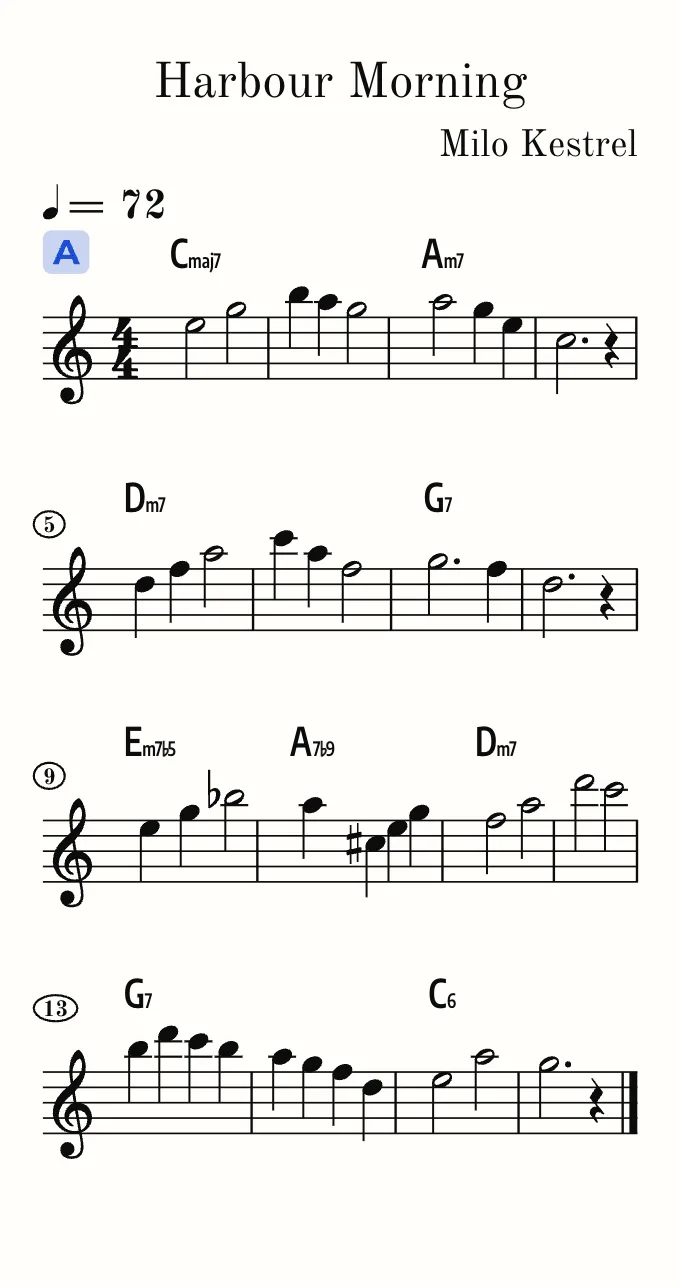
A lead sheet is a song written down at its bare minimum: the melody on a single staff, the chord symbols above it, and the lyrics, if there are any, under the notes. It is called a lead sheet because it carries the lead line, the melody. It tells you what the tune is, what the harmony is and how the form goes, and nothing about how to arrange it. The intro, the voicings, the bass line and the groove are left to the players.
That is why one page can serve a singer, a pianist, a guitarist and a sax player at the same time. Each reads the part they need: the singer the notes and words, the rhythm section the chords, the soloist both.
What's on a lead sheet?
From top to bottom, a typical lead sheet has:
- Title and composer, and often the lyricist.
- Style and tempo: a word or two ("Medium swing", "Bossa", "Ballad") and often a metronome mark such as ♩ = 120.
- Key signature and time signature at the start of the first staff.
- Rehearsal letters (A, B, C) in boxes, or section names (Verse, Chorus), at the start of each section.
- Chord symbols above the staff, placed over the beat where the chord changes. A chord lasts until the next symbol.
- The melody, in the treble clef, one note at a time.
- Lyrics under the notes, one syllable per note, with hyphens between syllables. Extra verses are often printed below the music.
- The road map: repeat signs, first and second endings, D.S. and coda signs, a Fine.
Laid out four bars (measures) to a line, the phrases line up down the page: an eight-bar phrase is two lines, a 32-bar tune is eight. When the page is laid out like that, you can see the form at a glance.
What does a lead sheet look like? A short example
Here is the opening of a song written for this article, in F major, 4/4, at a gentle tempo. On paper it would be two lines of four bars; here each bar is a row.
| Bar | Chord | Melody | Words |
|---|---|---|---|
| 1 | Fmaj7 | C, A, G, A (quarter notes) | Lamps a- long the |
| 2 | Dm7 | C, A (half notes) | ri- ver |
| 3 | Gm7 | B♭, A, G, F (quarter notes) | burn- ing in the |
| 4 | C7 | G (whole note) | rain, |
| 5 | Fmaj7 | C, A, G, A (quarter notes) | sha- dows on the |
| 6 | D7 | C, F♯ (half notes) | wa- ter |
| 7 | Gm7, C7 | G, E (half notes) | turn- ing |
| 8 | F | F (whole note) | home. |
In bar 7 the two chords share the bar: Gm7 on beats 1 and 2, C7 on beats 3 and 4, each written over its beat. Notice that the melody notes mostly belong to the chord above them: the F♯ in bar 6 is the third of D7, the E in bar 7 is the third of C7. Reading a lead sheet well is partly seeing that relationship (more in how to read a lead sheet).
Lead sheet symbols: what do they mean?
The symbols on a lead sheet are the same ones you meet on a band chart. The ones that come up all the time:
| Symbol | What it tells you |
|---|---|
| Fmaj7, Dm7, C7, Gm7♭5 | The chord to play from this beat until the next symbol |
| C/E | A slash chord: C, with E in the bass |
| N.C. | No chord: the rhythm section stops, the melody goes on alone |
| % | Play the previous bar again |
| ‖: and :‖ | Repeat the passage between them |
| 1. and 2. brackets | First and second endings: the first time, play the bar under 1.; the second time, skip to 2. |
| Segno (an S crossed by a slash, with two dots) | The place a D.S. sends you back to |
| Coda (a circle with a cross) | The ending section: jump to it at "To Coda" |
| Fermata (an arc over a dot) | Hold this note or chord |
| ♩ = 120 | 120 quarter-note beats a minute |
Chord symbols are written differently from one writer to the next (Cmaj7, CM7 or C with a small triangle, all for the same chord); chord symbols explained has them all.
What a lead sheet leaves out
A lead sheet is deliberately incomplete. It does not say:
- which voicing to play, or in which octave;
- the rhythm of the accompaniment, beyond the style word;
- the bass line or the drum part;
- the arrangement: how many times round, who solos, how it starts and ends.
All of that is decided by the band, on the spot or at rehearsal. A pianist reading Fmaj7 might play A, C, E and G in the left hand; a guitarist might play a four-note shape on the middle strings; the bass player plays roots and walks between them. The lead sheet only guarantees that everybody is on the same harmony at the same time.
When a part has to be exact, a horn line, a bass riff, a set of hits, it is written into the lead sheet or onto a separate part. On a jazz lead sheet you will sometimes see rhythm notation above the staff (slashes with stems, or small notes) for hits the whole band plays together; pushes, kicks and hits shows how they are read.
Lead sheet, chord chart or score: what's the difference?
| Melody | Chords | Lyrics | Parts for each player | |
|---|---|---|---|---|
| Chord chart | No | Yes, bar by bar | Sometimes | No |
| Lyric sheet with chords | No | Yes, over the words | Yes | No |
| Lead sheet | Yes, one staff | Yes, over the melody | Usually | No |
| Full score | Yes | Sometimes | If sung | Yes, every instrument |
A chord chart (a band chart, bars and chord symbols, not a guitar fingering diagram) is what a rhythm section reads when everyone knows the tune. A lead sheet adds the tune, which matters for anyone who has to play or sing it, and for anyone learning it. A full score writes out every instrument. Chord chart vs lead sheet vs score goes into which to bring to which gig.
Who uses lead sheets?
- Jazz musicians. A standard is learned and played from a lead sheet; a book of hundreds of them is a fake book.
- Singers, who bring a lead sheet in their own key so that the band plays where they sing.
- Songwriters, to fix a song on paper: melody, harmony and words on one page, without an arrangement.
- Function and church bands, where a pianist or guitarist may be handed a song at the last minute and needs both the tune and the changes.
Where to start if you need to make one
Write the chords first, four bars to a line, with the sections marked; then the melody over them; then the words. Check that each bar adds up to the time signature, and that the chord changes sit over the right beats. The detail, from clef to spacing, is in how to write a lead sheet.
In Gigplay, a song with a melody shows as a lead sheet in the Score mode: the melody on staves, the chords over them. You write the notes in the editor's Lead tab, on a piano keyboard, and they change key with the chords (Melody and lyrics).