A lead sheet gives you three things at once: the melody, written on a single staff; the harmony, as chord symbols above the staff; and often the lyrics, under the notes. To read one, take the header first (key, time signature, tempo, style), then the form (sections, repeats, endings), then read the melody bar by bar (measure by measure) while keeping an eye on where the chords change. The singer or horn player reads mostly the notes; the rhythm section reads mostly the chords; everyone reads the form.
What is on a lead sheet?
From top to bottom, a typical lead sheet has:
- A header: title, composer, style or feel ("medium swing", "slow ballad", "bossa"), and a tempo, as a word or a metronome mark.
- A clef, a key signature and a time signature at the start of the first staff. The clef is usually treble, at concert pitch, unless the sheet is a version for a transposing instrument.
- Section marks: letters (A, B) or names (Verse, Chorus) in boxes, at the start of each section.
- Chord symbols above the staff, each placed over the beat where the chord starts.
- The melody on the staff, with its rests, ties and pickups.
- Lyrics under the notes, one syllable per note, when the song has words.
- Road map signs: repeats, first and second endings, D.S., coda.
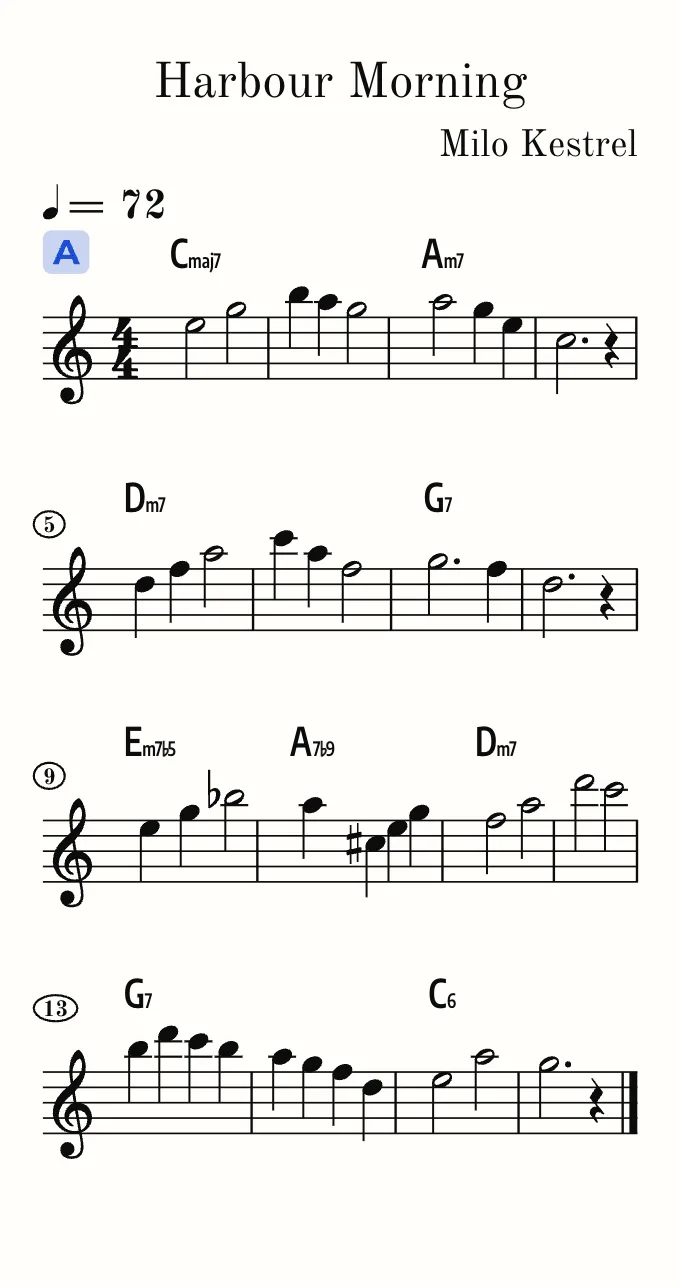
It does not have an accompaniment part, a bass line or drum notation. Those are left to the players, who build them from the chord symbols and the style. That is the whole idea of a lead sheet, and why it fits on one or two pages. What is a lead sheet? covers where it comes from and how it differs from a fake book page.
What does each player read on a lead sheet?
| Player | Reads mainly | Uses the rest for |
|---|---|---|
| Singer | Melody and lyrics | The chords tell them where they are in the form |
| Horn or melody player | Melody | Chords for solos and for fills |
| Pianist or guitarist | Chords | The melody, to avoid clashing with it and to play the intro |
| Bassist | Chords | The melody's rhythm, for hits and stops |
| Drummer | Form and style | The melody's phrases, to set them up |
Horn players may read a lead sheet transposed for their instrument: a lead sheet "in B♭" or "for E♭ instruments" has the melody and the chords written in that instrument's key, so a concert F major tune shows up in G for a trumpet and in D for an alto sax. Check which version you have before the count-in; transposing instruments has the table.
How do you read the chords against the melody?
A chord symbol holds until the next one. It sits above the note or the beat where it starts, so in a bar of 4/4 with "Dm7" over beat 1 and "G7" over beat 3, each lasts two beats. If a bar has no symbol, the chord before it carries on.
Here is the start of a lead sheet written for this article, a ballad in C, set out as a table: each column is one bar, with the chord, the melody notes and their lengths.
| Bar | 1 | 2 | 3 | 4 |
|---|---|---|---|---|
| Chord | Cmaj7 | Am7 | Dm7 G7 | Cmaj7 |
| Melody | E (half), G (half) | A (dotted half), B (quarter) | F (half), D (half) | E (whole) |
| Lyric | Slow-ly | morn-ing | on the | stair |
Two things to see. The melody note on a strong beat is very often a chord tone: E and G over Cmaj7, A over Am7, F over Dm7. Some chord tones are not the root: the D over G7 in bar 3 is its fifth. A note outside the chord, such as the B over Am7 at the end of bar 2 (its ninth), is a colour note: it adds to the chord without belonging to it. Notes outside the chord on weak beats, moving by step between chord tones, are passing notes. Reading a lead sheet well means noticing that relationship, because it tells a pianist which voicings will clash with the tune and tells a singer which notes are safe to hold.
How do you work out the key?
The key signature narrows it to two: one flat is F major or D minor, two sharps D major or B minor. Then look at the first and last chords and the last melody note. A tune with one flat that ends on F with an F chord is in F; one that ends on Dm is in D minor. Watch for tunes that change key in the middle section: the key signature may stay the same, and the accidentals and chords tell you instead.
What about pickups and the first note?
Many melodies start before the first full bar. A pickup (anacrusis) is a short incomplete bar at the start, often one to three beats: a bar of 4/4 with only a quarter note and a rest before it. The count-in runs straight into it: a one-beat pickup in 4/4 comes in on beat 4 of the count, and the first chord on the downbeat of the first full bar. Bar numbers on a lead sheet usually start at the first full bar.
How do you read the form?
Before reading a single note, find the shape of the song:
- Find the section letters and count the bars in each. Eight-bar sections are common, but not the only length.
- Find every repeat sign and every ending bracket. A lead sheet often writes the first A once with a repeat and two endings, so "A A" takes up the space of one section.
- Find any D.S., D.C. or coda, and where each one sends you.
- Write down, or say out loud, the order: "A, A, B, A, then from the sign to the coda".
A 32-bar tune written as A (with repeat and two endings), B, then A again is common enough to have a name; AABA and 32-bar form shows how it plays out. On a jazz gig, the form as written is played once as the head, then again for each solo chorus, then the head again to finish.
What are the small notes, slashes and words?
- Small notes (cue notes) are not the melody: they show a fill, a counter line or another player's part, and are optional.
- Rhythm slashes in a bar with no melody (an intro, a solo section) mean "play time on these chords".
- Rhythmic notation above the staff, slash note heads with stems, marks band hits; slash notation explains how to read it.
- Expressions like "rubato", "colla voce", "a tempo", "rit." tell you how strictly to keep time; a fermata over a note holds it.
- Alternate chords written small or in brackets are substitutes you may play.
How do you play a lead sheet on piano?
Start simple. The left hand plays the root of each chord where it changes, or a shell: root, third and seventh (for Dm7, D, F and C; for G7, G, B and F). The right hand plays the melody, adding a chord tone or two under it on the long notes. That alone sounds like a song. Then move the root to a bass player, if you have one, and try rootless voicings in the left hand: third, seventh and a colour note. Comping from a chord chart goes further into voicings and rhythm.
How should you practice reading lead sheets?
Read the melody alone first, slowly, saying the beats. Then play only the root of each chord on its beat, against the melody in your head, so that you feel where the harmony moves. Then put them together. Singing or playing the melody while comping the chords is the real test of a lead sheet: it is what a pianist accompanying a singer has to hear all the time.
Gigplay shows a song with a melody as a lead sheet in its Score mode, or as Chords+Melody, the chart with the melody on a small staff in each measure (Reading a song). Both follow the key you choose. To hear the melody, turn on Lead in the player's options: the band then plays it with you.
If the song has no written melody, you are reading a chord chart instead, which uses the same symbols and the same road map, without the staff. Chord chart vs lead sheet sets out when each one is the better choice.