This is about the chord chart a band reads, the song's chords laid out bar by bar (measure by measure), not the guitar diagram that shows where to put your fingers for one chord. Each box between two barlines is one bar; the chord symbols in it say what harmony sounds there; the signs around them say in what order to play the bars. Read it left to right, row by row, counting beats.
Chord chart or chord diagram: which one do you have?
A chord diagram (a fret diagram, a chord box) shows one chord on the guitar: six vertical lines for the strings, horizontal lines for the frets, dots where the fingers go. A band chord chart shows a whole song, in bars, with chord names and no fingerings. The whole band reads the same chart, each player on their own instrument.
What does a band chord chart look like?
Here is the opening of a song written for this article, a medium swing in F, as a chart would set it out, four bars a row:
| Bar 1 | Bar 2 | Bar 3 | Bar 4 |
|---|---|---|---|
| A: Fmaj7 | D7 | Gm7 | C7 |
| Am7 D7 | Gm7 C7 | Fmaj7 | % |
| B: Cm7 | F7 | B♭maj7 | B♭m7 E♭7 |
| Am7 | D7 | Gm7 | C7 |
Read across the first row: one bar of Fmaj7, one of D7, one of Gm7, one of C7. In the second row each of the first two bars has two chords, so each chord lasts half the bar. The % in bar 8 means "same as the bar before": another bar of Fmaj7. "A" and "B" are section letters, there so the band can talk about the form ("from the B").
What does the header of a chord chart tell you?
Before the first bar, look at the header. It usually gives:
- The title and the composer.
- The key, sometimes only implied by the key signature or the first and last chords.
- The style or feel: swing, bossa, ballad, funk, "even eighths", "shuffle". This tells the rhythm section what to play more than anything else on the page.
- The tempo, as a metronome mark (♩ = 140) or a word.
- The time signature, at the start of the first row. If it changes later, a new one appears where it changes (and 6/8 is not read like 3/4).
Read all of it before you count in. A chart in 3/4 read as 4/4 falls apart in the second bar.
How do you know how long each chord lasts?
The bar is the unit. The common rules:
- One chord in a bar lasts the whole bar.
- Two chords in a bar of 4/4 split it evenly: two beats each. Two chords in a bar of 3/4 are ambiguous: look for slashes or spacing that say which one gets two beats, and if there are none, ask.
- Three or four chords in a bar are placed where they fall. A chart may space them so their position in the box matches their beat, or add slashes, one per beat, so that "C7 / F7 /" means two beats of each and "C7 / / F7" means three beats of C7 and one of F7.
- A chord written above a rhythm (stems, beams, an accent) is a hit: the whole band plays that rhythm together.
- N.C. means no chord: the harmony players stop until the next chord symbol.
How do you read the chord symbols?
Each symbol is a root, then a quality, then extensions or alterations, sometimes a bass note after a slash:
| Symbol | Read it as | Notes in it |
|---|---|---|
| F | F major | F A C |
| Fm | F minor | F A♭ C |
| F7 | F seven (dominant) | F A C E♭ |
| Fmaj7 | F major seven | F A C E |
| Fm7 | F minor seven | F A♭ C E♭ |
| Fm7♭5 | F half-diminished | F A♭ C♭ E♭ |
| F°7 | F diminished seven | F A♭ C♭ E♭♭ |
| F/A | F major over A in the bass | A in the bass, F A C above |
Writers vary: a major seventh may be Fmaj7, FM7 or F with a triangle; a minor may be Fm, Fmin or F with a short dash. The chord symbols cheat sheet goes through every common one. On a chart, a symbol is an instruction about harmony, not a voicing: a pianist may play F7 as A, E♭, G and D (no root, a ninth and a thirteenth added), a guitarist as a three-note shell, and both are right. The chart tells you the harmony; which notes you play, and in what rhythm, is your part of the job. Comping from a chord chart is about exactly that.
What do the section letters and double barlines mean?
Double barlines mark the end of a section. Letters (A, B, C) or names (Intro, Verse, Chorus, Bridge, Solos) in boxes above the first bar of a section are rehearsal marks. Two sections with the same letter have the same, or nearly the same, chords: a tune laid out A A B A has a first section played twice, a contrasting B, and the first section again.
How do repeats, endings and codas change the order?
The order you play the bars in is the road map, and every jump in it is a place to get lost. The signs:
- Repeat barlines, a thick and a thin line with two dots (typed,
|:and:|; in Gigplay, a brace with two dots): play the passage between them again. With no start repeat, go back to the beginning. - First and second endings, brackets numbered 1 and 2 over the last bars: the first time take ending 1, the second time skip it and play ending 2. See repeat signs and endings.
- % in a bar, or a double sign written across a barline with a "2" over it: repeat the previous one or two bars.
- D.C. (from the head), D.S. (from the sign, the segno: a slanted S with a stroke and two dots), al Fine (play to the word Fine and stop), al Coda (play to the To Coda mark, then jump to the Coda, marked with a circle crossed by two lines). These send you back through the chart; D.S. al Coda explained spells out a full road map.
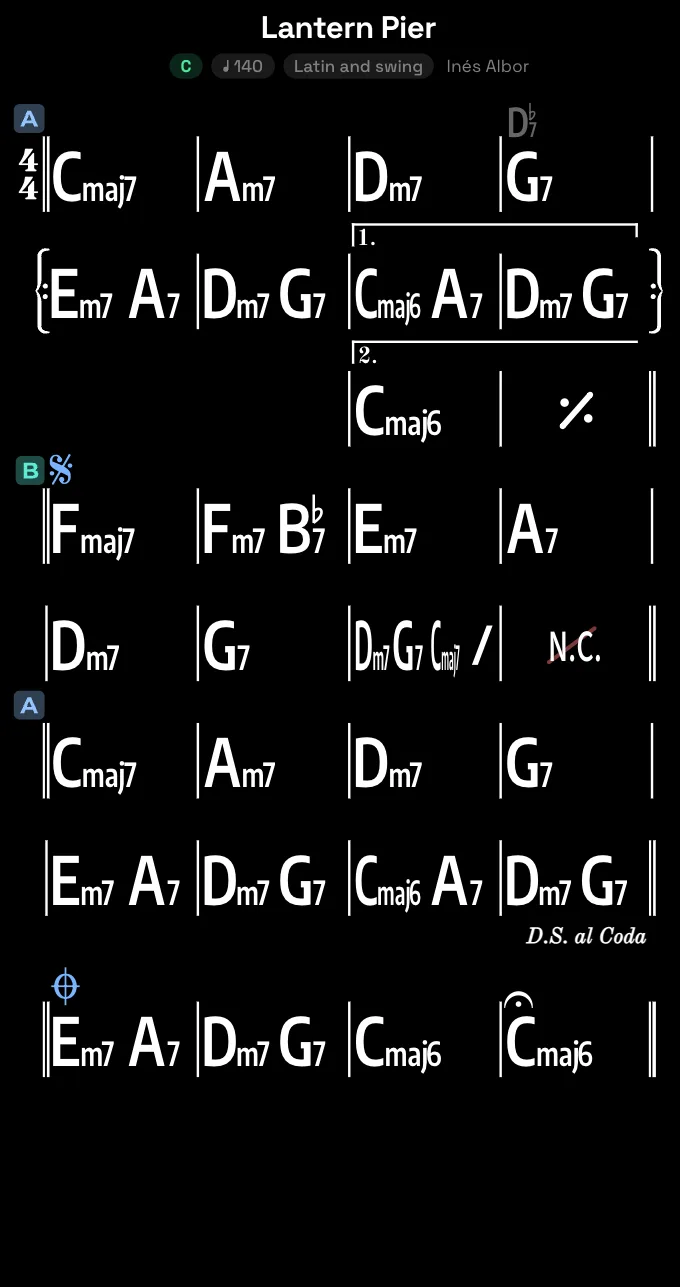
The chart above has most of these signs: section letters, a repeat drawn with braces and dots, first and second endings, a %, a segno at B, an N.C. bar, D.S. al Coda and a Coda. It has no separate To Coda mark. When a chart leaves it out, the band has to agree where the jump is: ask before the count-in. The small chord above the G7 in the first row is an alternate chord: a substitute the writer suggests, which you may play or not.
How do you read a chart on the gig without getting lost?
A few habits that help:
- Count the bars, not the chords. A bar with four chords takes no longer than a bar with one.
- Look ahead. Your eyes should be on the next bar, or the next row, while your hands play this one. At the end of a row, already be on the next.
- Watch the section changes. Double barlines, endings and jumps are where a reader goes wrong. Keep a mental "where am I in the form": second A, bridge, last A.
- Hear the shape. Gm7 C7 F is a ii–V–I (2-5-1, ii-V-I) in F; once you hear progressions as units, you read them as units, the way you read words instead of letters.
- When you get lost, find the next section. Lay out for a bar, listen for the bass and the drummer's fill into the next section, and come back in at a section letter.
Does a jazz chord chart read differently?
Not in its layout. A jazz chart uses more four-note chords and extensions (Gm9, C7♭9, F6/9), often has only the head written out, and expects you to play the form round again for each solo: one time through the form is one chorus. "Solos on AABA" or "open solos" written on the chart means exactly that. Some charts use Nashville numbers instead, degrees in place of chord names, a system Nashville session musicians developed in the late 1950s; the Nashville number system reads the same way, bar by bar. The chart may give no intro or ending at all, leaving them to the bandleader's cue. If you want the melody as well, you need a lead sheet, which puts the tune on a staff under the chords.
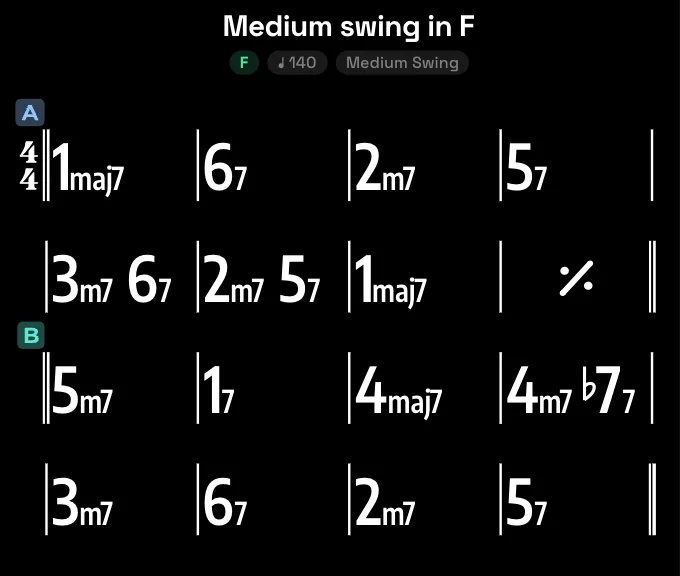
In Gigplay, the same chart can be read as letters, as Roman numerals or as Nashville numbers with Chords as, and in any key, spelled correctly for that key (see Reading a song). Reading a chart you know in degrees is a good way to start hearing its progressions as shapes.
What should you check before the count-in?
- The key, the time signature and the feel.
- The tempo, or who counts it in.
- The road map: repeats, endings, D.S. or D.C., the coda.
- Any hits, N.C. bars or breaks.
- How it ends: a written ending, a fermata, a vamp till cue, a fade.
Then say the road map out loud, once, before the count-in: "intro, A twice, B, A, D.S., coda". If anyone in the band hears it differently, you find out now, not halfway through the tune.