D.S. al Coda means "go back to the sign (the segno), play from there until you reach the To Coda mark, then jump to the section marked Coda". D.C. al Fine means "go back to the beginning and play until the word Fine, where the piece ends". D.C. sends you to the top, D.S. to the sign; "al Coda" ends with a jump to the coda, "al Fine" with a stop at Fine. On the first time through, you ignore the To Coda and the Fine: they only count after the jump back.
What do D.C., D.S., Fine and Coda mean?
They are Italian, and the literal meanings help. The segno looks like a slanted S with a stroke through it and a dot on each side; the coda sign is a circle with a cross through it, the lines running past the edge.
| Term | Italian | Literally | On the chart |
|---|---|---|---|
| D.C. | Da capo | From the head | Go back to the very beginning |
| D.S. | Dal segno | From the sign | Go back to the segno |
| Fine | Fine | End | Stop here, but only after a D.C. or D.S. |
| Coda | Coda | Tail | The ending section, marked with the coda sign |
| To Coda | — | To the tail | The exit: jump from here to the Coda, after a D.C. or D.S. |
Put together, the four everyday instructions are:
- D.C. al Fine: back to the beginning, play to Fine, stop.
- D.C. al Coda: back to the beginning, play to To Coda, jump to the Coda.
- D.S. al Fine: back to the sign, play to Fine, stop.
- D.S. al Coda: back to the sign, play to To Coda, jump to the Coda.
A bare "D.C." or "D.S." with no "al" means go back and play to the end of the piece, or to the Fine if there is one.
What is the difference between "To Coda" and "Coda"?
Both usually carry the same sign, the circle with a cross, which is why they get mixed up.
- To Coda (or the coda sign alone, over a barline in the middle of the chart) is the exit. It marks the place you leave from.
- Coda (the sign with the word, at the start of a separate section, often set apart at the bottom of the page) is the destination.
You pass the To Coda mark the first time through without doing anything. Only on the way through after the D.S. (or D.C.) do you take it.
How does D.S. al Coda play out bar by bar?
Here is a chart of 26 bars (measures) in C, written for this article. The segno is at the start of A, and A has a repeat with first and second endings. The To Coda is at the end of A's second ending; the D.S. al Coda is at the end of B. As a plain-text chart, with (S) for the segno and (+) for the coda sign:
Intro    | Cmaj7 | Am7   | Dm7   | G7    |

A  (S)   |: C    | Em7   | F     | G7    |
         |  C    | Em7   |1. F G7 | C G7  :|
                         |2. F G7 | C     || To Coda

B        | Am    | F     | C     | G     |
         | Am    | F     | Dm7   | G7    || D.S. al Coda

(+) Coda | F     | G7    | C     | C (fermata) ||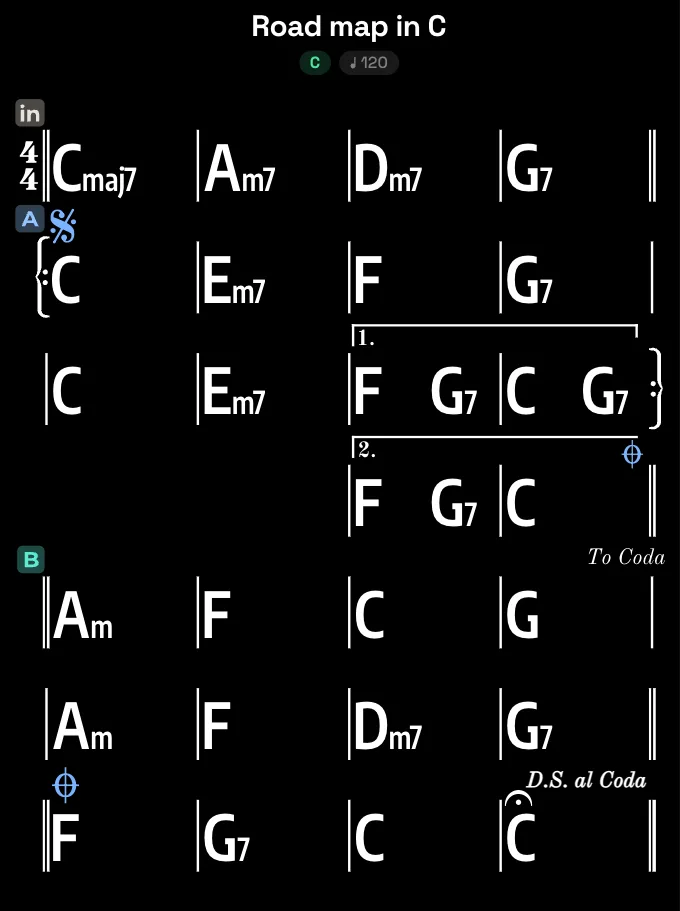
Numbered, the intro is bars 1–4; A is bars 5–10, with the first ending in bars 11–12 and the second in bars 13–14; B is bars 15–22; the Coda is bars 23–26. The road map, as played:
| Step | You play | Then |
|---|---|---|
| 1 | Intro, bars 1–4 | Go on |
| 2 | A, bars 5–10, first ending 11–12 | Repeat sign: back to bar 5 |
| 3 | A, bars 5–10, second ending 13–14 | Pass the To Coda: first time, ignore it |
| 4 | B, bars 15–22 | D.S. al Coda: back to the sign, bar 5 |
| 5 | A, bars 5–10, second ending 13–14 | No repeat after the jump; at the To Coda, jump |
| 6 | Coda, bars 23–26 | Hold the last chord; the end |
Twenty-six written bars, forty played: intro, A, A, B, A, coda. Two things to notice. The intro is not played again, because the sign is after it: that is the whole reason for D.S. instead of D.C. And after the D.S., A is played once, going straight to the second ending, which is where the To Coda sits.
Do you play the repeats after a D.S. or D.C.?
There is no answer that holds for every chart. Classical music has one clear case: in a minuet and trio, the minuet played again after the trio is played without its repeats, by convention. The example above follows the same idea, so in step 5 you go straight to the last ending. But some players expect the repeat played again, especially when a verse has a second set of lyrics. Played that way, step 5 becomes A twice, with both endings, and the song is eight bars longer. If the chart doesn't say ("D.S. al Coda, with repeat" or "no repeat"), ask; and if you write the chart, say which. Repeat signs and endings goes through endings and passes in detail.
How does D.C. al Fine play out?
The simplest form:
| Section | Written bars | Signs |
|---|---|---|
| A | 1–8 | Fine at the end of bar 8 |
| B | 9–16 | D.C. al Fine at the end of bar 16 |
Played: A (ignore Fine), B, back to the top, A, stop at Fine. A B A, twenty-four bars from sixteen written. The final barline is not at the end of the page but at the Fine, often a double barline with the word under it.
What if the Fine is in a first ending?
This one catches people out, and it can turn up on an AABA tune. The A section is written once, with a repeat: its first ending closes on the home chord and carries the Fine; its second ending leads into B.
| Section | Written bars | Signs |
|---|---|---|
| A | 1–6, first ending 7–8, second ending 9–10 | Fine at the end of bar 8 |
| B | 11–18 | D.C. al Fine at the end of bar 18 |
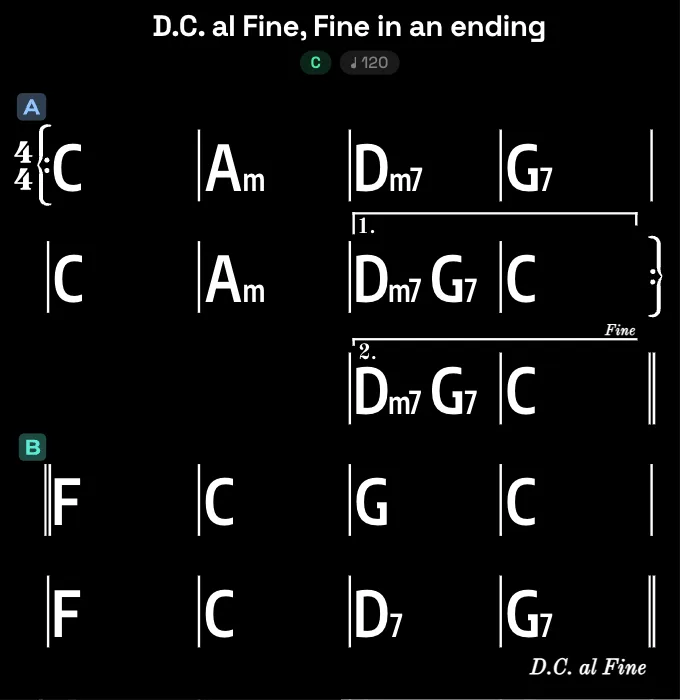
Played: A with the first ending (1–8, ignore Fine), A with the second ending (1–6, 9–10), B (11–18), back to the top, then A with the first ending (1–6, 7–8) and stop at the Fine. That is A A B A, 32 bars from 18 written. Here the rule "take the last ending after a jump" gives way: you take the ending the Fine is in, because that is where the piece ends.
When is the coda taken on a jazz chart?
On a tune played head, solos, head, the road map applies to the last time through the head. Solos are played over the form without the D.S. jump; the bandleader may signal "last head", and only then do you take the D.S. and the coda. A chart may write it out: "solos on AABA, after solos D.S. al Coda" or "last x to Coda". What "a chorus" means in jazz explains how the form is counted round.
Some charts have a To Coda sign but no D.S. or D.C. at all. Most likely the coda is a tag on the very last chorus (ask to be sure): play the form as written each time, and on the last one, jump to the coda from the sign. Intro, outro and coda has more on how codas, tags and outros differ.
What mistakes do people make with D.S. al Coda?
- Jumping to the Coda the first time through. The To Coda waits for the D.S.
- Going back to the top instead of the sign. On a chart where the segno is a few bars in, D.C. and D.S. give different bars; look for the sign before you play.
- Taking repeats after the jump when the chart means not to, or the reverse.
- Not finding the coda fast enough. It is often at the bottom of the page, or on the next page. Know where it is before you need it.
How do you mark a chart so you never miss the jump?
- Circle the segno, the To Coda and the Coda in the same colour.
- Draw an arrow from the To Coda towards the Coda, and write "2nd x" beside it.
- Write the full road map in words at the top: "Intro, A, A, B, D.S., A (2nd ending), Coda".
- At a rehearsal, say it out loud before the count-in, so everyone hears the same plan.
For the end itself, the chart may give you a fermata, a "ritard" or a "button" (a short final hit); how to end a song live covers what each one sounds like. Other words you will see near the end of a chart, such as tacet, fine and tutti, are in chart words explained.
Gigplay's chord editor has the Segno and the Coda under Marks, and D.C. and D.S. al Coda or al Fine, and Fine, under Directions (see Writing and editing a chart). Example Tune, one of the songs that come with the app, has a segno and a coda: start the Player and watch the lit bar follow the road map. The band plays it with no repeats after the jump. Set it to play the form more than once and it takes the D.S. and the coda every time through, not only on the last.