To transpose chords, work out the distance from the old key to the new one, then move the root of every chord, and every bass note after a slash, by that same distance. Only the root and bass letters move; the chord type stays. Am7 a whole step up is Bm7, a half step up B♭m7, G7 stays a dominant seventh, D/F♯ becomes E/G♯. Last, spell the new chords with the new key's letters, so a chart in E♭ shows A♭ and not G♯.
That is all transposing is. The rest of this page is how to do it quickly, on a band chart written bar by bar (not a guitar fret diagram), without the slips that turn up at rehearsal.
How far apart are the two keys?
Count half steps (semitones) from the old key's tonic up to the new one, on the chromatic scale: every note, one half step apart, until the octave.
C C♯/D♭ D D♯/E♭ E F F♯/G♭ G G♯/A♭ A A♯/B♭ B CTwelve half steps make an octave, so 10 up lands on the same key as 2 down: count whichever way is shorter.
| Half steps up | Interval | From C | From G |
|---|---|---|---|
| 1 | minor 2nd (half step) | D♭ | A♭ |
| 2 | major 2nd (whole step) | D | A |
| 3 | minor 3rd | E♭ | B♭ |
| 4 | major 3rd | E | B |
| 5 | perfect 4th | F | C |
| 6 | tritone | F♯ or G♭ | C♯ or D♭ |
| 7 | perfect 5th | G | D |
| 8 | minor 6th | A♭ | E♭ |
| 9 | major 6th | A | E |
| 10 | minor 7th | B♭ | F |
| 11 | major 7th | B | F♯ |
A song in G moved to B♭ goes up 3. A song in A moved to F goes down 4 (or up 8, the same key).
What is the fastest way to transpose a chord chart?
Write the distance at the top of the page, then go through the chart chord by chord and move each root by it. Leave everything after the root alone: m7, maj7, 7♭9, sus4 and add9 mean the same thing in any key.
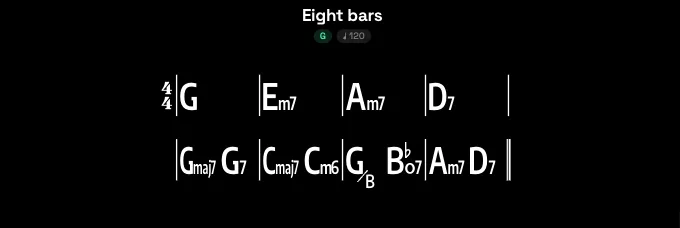
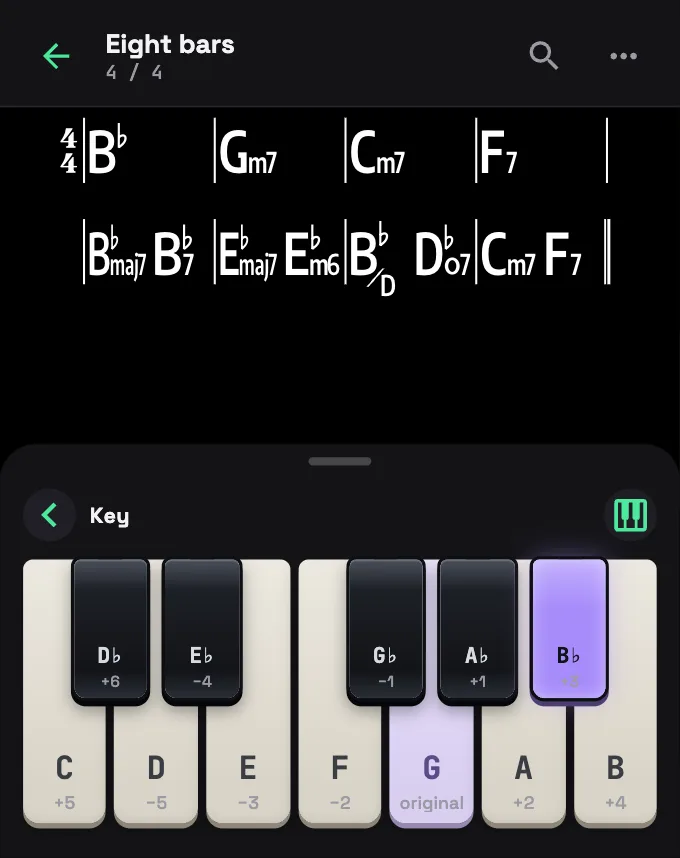
Here is an eight-bar (measure) passage in G, written for this page, taken up 3 half steps to B♭:
| Bar | In G | In B♭ (+3) |
|---|---|---|
| 1 | G | B♭ |
| 2 | Em7 | Gm7 |
| 3 | Am7 | Cm7 |
| 4 | D7 | F7 |
| 5 | Gmaj7, G7 | B♭maj7, B♭7 |
| 6 | Cmaj7, Cm6 | E♭maj7, E♭m6 |
| 7 | G/B, B♭°7 | B♭/D, D♭°7 |
| 8 | Am7, D7 | Cm7, F7 |
Where a bar has two chords (two beats each), each moves on its own. In bar 7 the bass walks down B, B♭, A in G, so in B♭ it walks D, D♭, C, and the diminished chord is spelled D♭°7, not C♯°7: the bass is falling.
How do you transpose with numbers instead?
The other way is to stop thinking in letters. Name each chord by its degree in the old key, then read those degrees in the new key. G Em7 Am7 D7 is 1, 6m7, 2m7, 5⁷ in G; in any other key it is still 1, 6m7, 2m7, 5⁷. This is exactly how the Nashville number system works, and why a number chart needs no rewriting for a new key.
It helps to know the chords that belong to each key. Here are all twelve; read across to name a chord's degree, then down the same column to find it in the new key.
| Key | I | ii | iii | IV | V | vi | vii° |
|---|---|---|---|---|---|---|---|
| C | C | Dm | Em | F | G | Am | B° |
| D♭ | D♭ | E♭m | Fm | G♭ | A♭ | B♭m | C° |
| D | D | Em | F♯m | G | A | Bm | C♯° |
| E♭ | E♭ | Fm | Gm | A♭ | B♭ | Cm | D° |
| E | E | F♯m | G♯m | A | B | C♯m | D♯° |
| F | F | Gm | Am | B♭ | C | Dm | E° |
| F♯ | F♯ | G♯m | A♯m | B | C♯ | D♯m | E♯° |
| G | G | Am | Bm | C | D | Em | F♯° |
| A♭ | A♭ | B♭m | Cm | D♭ | E♭ | Fm | G° |
| A | A | Bm | C♯m | D | E | F♯m | G♯° |
| B♭ | B♭ | Cm | Dm | E♭ | F | Gm | A° |
| B | B | C♯m | D♯m | E | F♯ | G♯m | A♯° |
Once a progression is in numbers, a ii–V–I (2-5-1) is a ii–V–I wherever you play it, and you start to hear songs that way too. The half-step method is quicker for a one-off; the number method is better when you will play the song in several keys, or want to know it rather than read it.
How do you spell the new chords correctly?
Every major scale uses each letter once, so the chords in a key take their names from that key's notes. In E♭ the fourth chord is A♭, because E♭ major has A♭ in it; G♯ is the same key on a piano but the wrong name on the page.
A few rules settle almost every case:
- Diatonic chords take the key's own spelling: in B major the vi is G♯m, not A♭m.
- Chords borrowed from the minor side are flattened degrees: the ♭VII in D is C, the ♭VI in A is F, the ♭III in E is G.
- Chords leading up to a chord of the key are sharpened: a III7 that pushes to vi in E is G♯7 (it resolves to C♯m).
- Pick the key with fewer accidentals: D♭ (five flats) rather than C♯ (seven sharps). F♯ and G♭ tie at six: choose the one your band reads more easily.
The reasons, and a chart of every key signature, are in Key signatures and enharmonic spelling.
How do you transpose slash chords, minor keys and melodies?
- Slash chords: move both letters by the same distance. C/E up a whole step is D/F♯; Am/G down a minor 3rd is F♯m/E.
- Minor keys: count from the minor tonic. Am to Cm is up 3; the relative major goes along with it (C becomes E♭).
- The melody: every note moves by the same interval, and the key signature changes with it. Up 5 and down 7 give the same key but a melody an octave apart: choose by where it sits for the voice or instrument.
- What does not change: N.C., repeats, endings, the form, the rhythm, the tempo.
In Gigplay, the Key pad shows the song in any key: the chords are spelled for the new key, and the melody and the backing band move with them. The key you pick is remembered in each playlist, so a singer's set can have a song in F while your own list keeps it as written (see Changing key).
Which key should you move it to?
That depends on who the change is for.
- A singer: find the key where the highest note of the melody sits just below the top of their comfortable range. What key should I sing in? goes through it step by step.
- A guitarist: a capo can turn a hard key into easy shapes without rewriting anything; the capo chart shows which fret gives which key.
- Horns and clarinets: a trumpet or saxophone part is written in another key even when the song does not change. That is not transposing the song; it is reading for a transposing instrument, and the two are easy to mix up.
What goes wrong most often?
- Changing the quality. Am7 up a whole step is Bm7. If a B7 appears, a minor chord has turned into a dominant.
- Forgetting the bass note. C/G moved up 2 is D/A; it is easy to move the C and leave the G behind.
- Mixing sharps and flats. A chart in A♭ should not contain a C♯m or a G♯: the borrowed iv is D♭m, and the V of vi is C7, not B♯7. Sharps in a flat key, or flats in a sharp key, are worth a second look: they may be a slip in spelling.
- Counting the wrong way. Up 3 and down 9 land on the same key. Write the direction and the number at the top before you start.
- Expecting a PDF to change by itself. A scanned chart is a picture of notes; it has to be rewritten, not shifted. See Can you transpose a PDF chart?
Go through the chart once more when you are done and read the new chords as numbers. If the numbers match the old chart's, the transposition is right.